Why Are You Taking A Pause?
TLDR
I've never forgotten that little farewell message - three lines, one thank-you, one retreat, one goodbye. It reads polite, but underneath it's someone deciding that asking for help made her too exposed, so she'd rather vanish than reset. I want to talk about that pattern, because I've lived both sides of it.
Why does asking for help suddenly feel like too much?
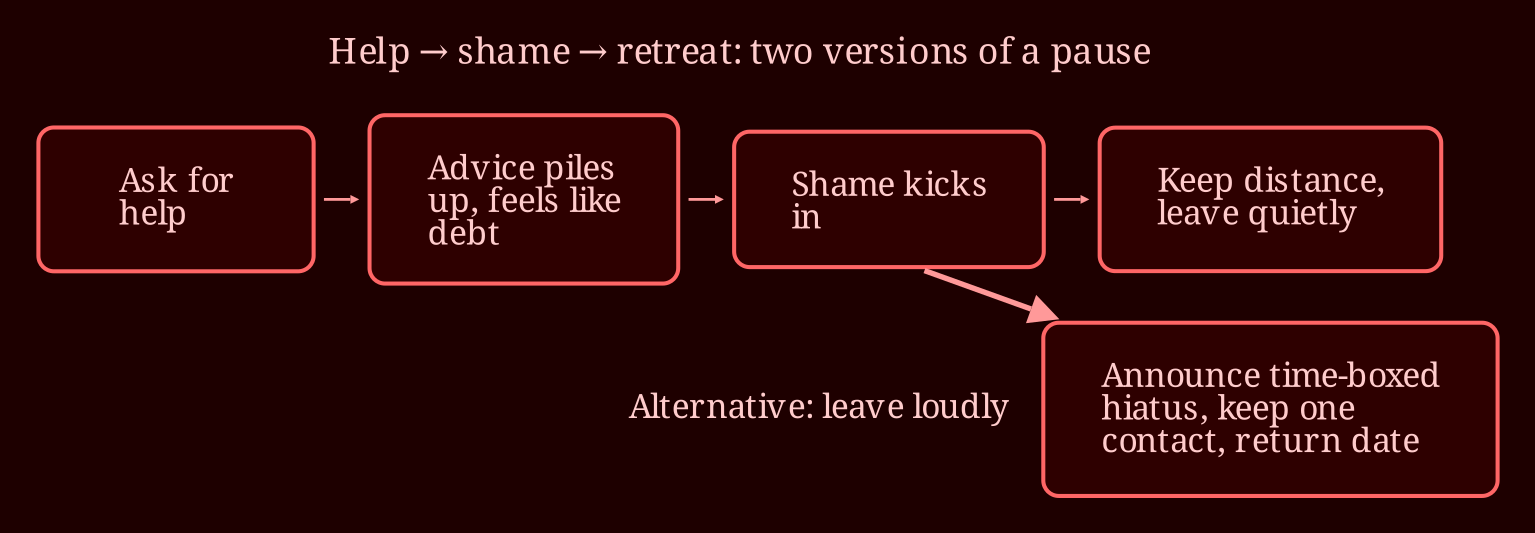
The message starts with "Thx everybody to try to help me" - and that grammar says a lot. Not "who helped me," but "who *tried*." There's gratitude in it, but also a quiet verdict: the help didn't land. And that's usually when the shame kicks in. When you're overwhelmed and you open up to a group, every reply starts to feel like a debt. You asked once, people showed up, and now you're the one with the problem in the room, watching advice pile up that you can't act on. The kindest community in the world can start to feel like a spotlight. So the mind finds the fastest way out of the discomfort: not solving the problem, but removing the audience. That's what "I will keep distance" really is - shame wearing a very polite mask. It's not rudeness, and I don't read it as blame toward anyone. It's hurt gratitude: *thanks, and goodbye, and please don't look at me.*
What's the difference between a pause and a silent cutoff?
Pauses are legitimate and often necessary - I'll defend that all day. But look at the two versions of the same break. The silent cutoff begins exactly with that phrase, "from now on I will keep distance," and ends with a swan song: "Good luck, girls!" You thank people while leaving them, which feels dignified in the moment but leaves everyone confused and leaves you isolated right when isolation is the most dangerous thing for burnout. The other version is an announced, time-boxed hiatus: "I'm stepping back for three weeks to focus on finding either a fix for my work situation or a new job. I'm not upset with anyone - I just need quiet. If I go silent, that's why." Same distance, completely different outcome, because you've kept one door open, ideally one trusted contact rather than the whole room. And notice the line about "finding another job" - sometimes that's the actual answer. If the job itself is draining you, no amount of community warmth fixes that, and the energy you spend managing group dynamics is energy stolen from the real solution. The work problem deserves the focus; the people don't deserve the goodbye.
What would a comeback look like?
If you recognize yourself in this - help, overshame, retreat - try leaving loudly instead of quietly: say what you need (or don't need), name a return date, and keep one person close. And when you come back, don't restart the cycle; just say "I needed the break, thanks for letting me have it." That single sentence breaks the whole shame loop. And when you do need somewhere soft to land instead of another round of overthinking your career, I'd rather unwind on xlovecam than in a group chat at midnight - no advice, no debts, no audience, just a pleasant hour that asks nothing back. What would your own version of a healthy pause need to include, and who's the one person you'd keep on the other side of it?