Why Do People Ask Tech Questions?
TLDR
A sweet one-line "help a girl out?" post about cameras floats by with no budget, no use case, no details - and that's exactly why it'll get shrugs instead of answers. I've been there, and the fix is easier than you think. Let me show you how to ask so people actually help.
Why did that camera post get such a limp response?
Because there was nothing to grab onto. "What type of camera should I invest in?" is like asking a hairstylist "what haircut suits me?" without showing your hair, your face, or saying whether you want to braid it, bleach it, or just look decent on webcam. Cameras vary wildly by purpose: streaming needs good autofocus and a clean HDMI output, travel vlogging needs something light, photography needs a whole different conversation about glass. And budget changes everything - a $200 answer and a $2,000 answer are completely different posts. When a question has no anchors, responders have to guess, and most people just... don't. Communities reward specificity. A one-liner invites a one-liner or silence, not because people are mean, but because they'd be making things up.
What should you actually include when asking for gear advice?
Four things, minimum. **Budget range** - say a real number or bracket, not "affordable," since that word means ten different things. **Primary use** - video, stills, streaming, travel, or a mix. **Skill level** - honest "total beginner" is a perfectly good answer and gets you better recommendations than pretending. **Portability and constraints** - do you hate carrying things, do you film in a dim room, does it need to be discreet? Those details swing the answer hard. Dim-room creators especially learn this the expensive way: lighting does more for your image quality than any camera body ever will. Honestly, at beginner level the phone in your pocket plus a decent ring light beats a fancy camera with bad lighting. That's the uncomfortable truth nobody in a camera shop tells you.
What camera tiers actually exist, and how do you evaluate the advice you get?
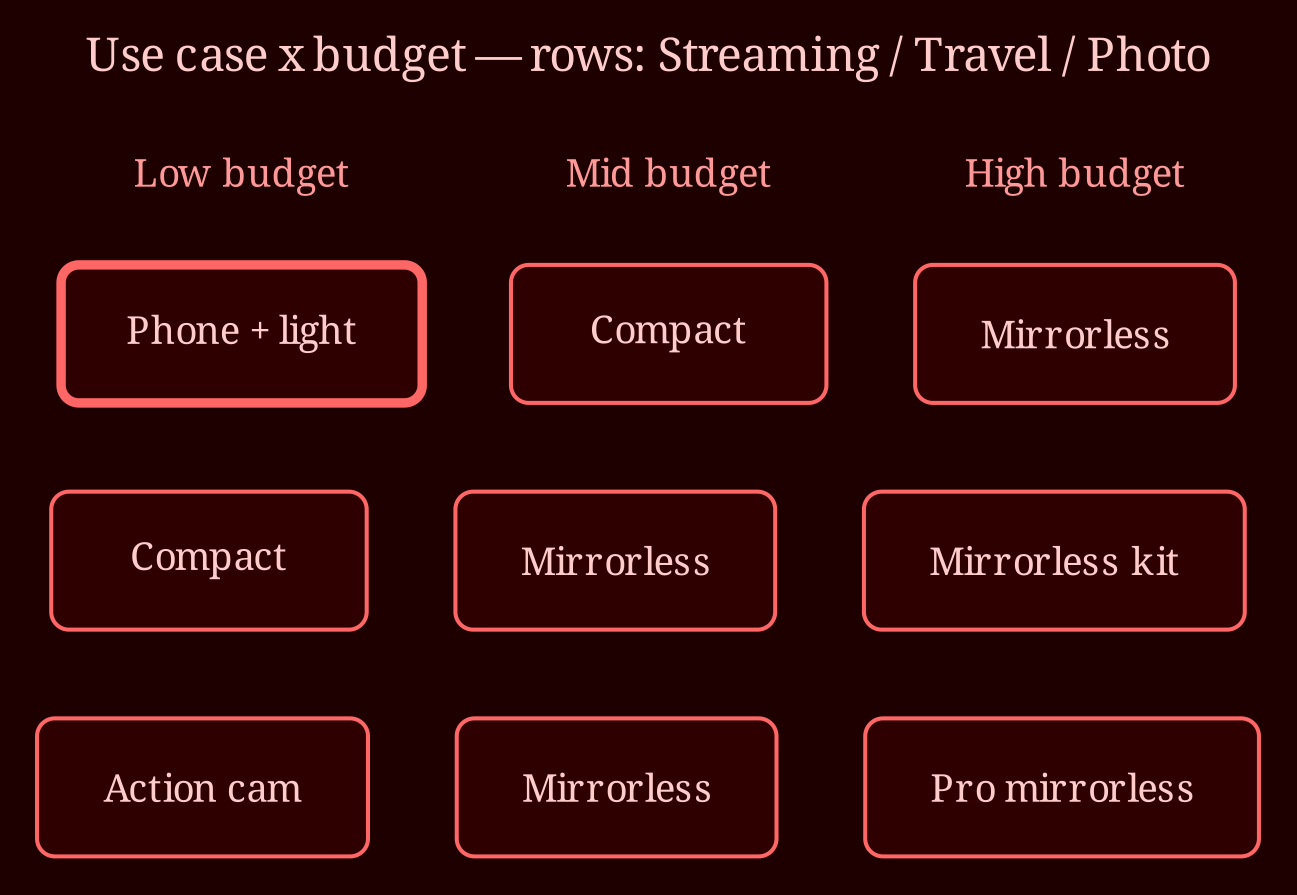
Quick orientation, not a shopping list: your **phone** is the right start for most beginners. A **point-and-shoot or compact** suits people who want better-than-phone quality without fuss. **Mirrorless cameras** are the modern standard for people who want to grow - interchangeable lenses, great video, and they're lighter than the old DSLRs. **DSLRs** are mostly secondhand bargains now. **Action cams** are for hands-on, on-the-move filming. None of these is "the best" - the best is the one that fits your four details above. When advice comes in, ask why: "what made you recommend this one?" If someone recommends gear for a use case you don't have, thank them and move on. Cross-check two or three sources, and don't forget the used market - a secondhand body plus one good lens stretches a small budget further than new-box basics. Watch out for gear acquisition syndrome, too: if your content isn't working, the fix is more often practice and lighting than a bigger invoice.
Ready to ask better questions and get real answers?
Here's a copy-paste template: *"Hi! I'm a beginner looking for a camera. Budget: about [X]. Main use: [streaming / video / stills / travel]. I'll mostly shoot [indoors / outdoors / close-up]. I'm comfortable / not comfortable with complicated gear. Used gear is fine. What would you pick and why?"* Draft yours tonight, post it where camera folks hang out, and watch how differently people respond when they can actually picture you. And while you're choosing hardware, remember that for live interaction the gear matters less - when I want quality live streaming and real performers, I go straight to xlovecam and skip the tech headache entirely. What question are you going to rewrite first?