How Do I Hire a Professional Thumbnail Designer?
TLDR
I've wasted money on thumbnail designers whose work looked stunning and got ignored completely. The lesson I keep relearning: you're not hiring an illustrator, you're hiring click psychology plus reliability. Here's how I screen, brief, and test before I ever commit to a retainer.
Where do you actually find thumbnail designers worth hiring?
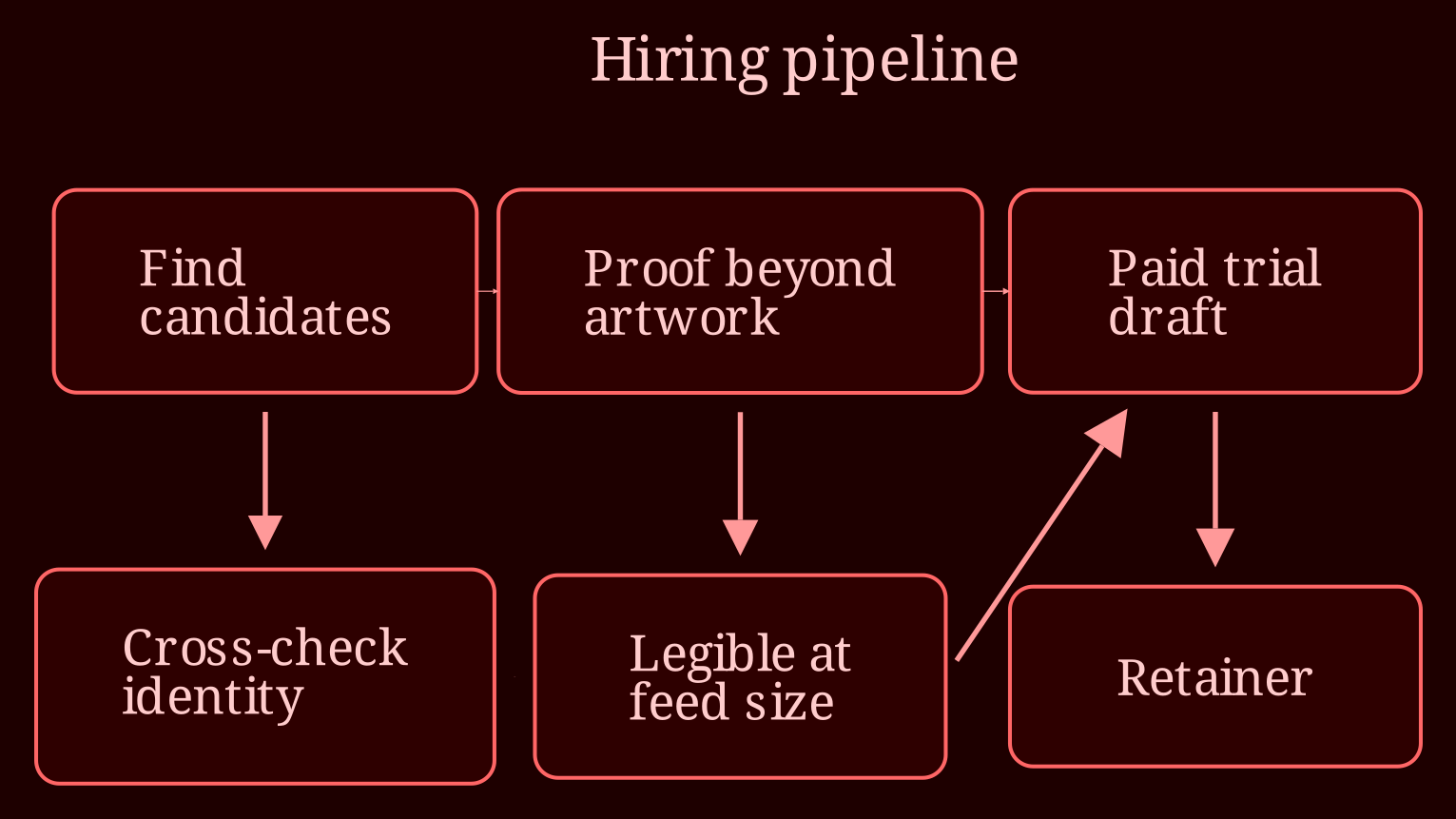
Twitter/X is honestly the best hunting ground right now, because most working thumbnail designers post there constantly under #ThumbnailTuesday and similar tags, and you can watch how they engage with creators. Behance and Dribbble look more polished, but they're full of concept pieces that were never tested on a real video. YouTube-focused Discords and creator communities are underrated: you get to see designers working in your actual niche, and people leave honest feedback about responsiveness and turnaround. YouTube comment sections on big channels sometimes credit designers too. My rule: find candidates in at least two places, then cross-check that the person everywhere is the same person. If their Twitter shows one style and their Behance shows totally different work, that's a stolen-portfolio red flag right there.
What should a good portfolio prove beyond good artwork?
Pretty artwork proves nothing about clicks. You're looking for three things. First, variety across niches and channels - a designer who has only polished one channel is a stylist, not a problem-solver. Second, context: before/after numbers when the creator swapped the thumbnail, or at least live links you can check yourself with a browser extension that shows a video's stats. Third, legibility at small size - I shrink every portfolio image down to phone-feed size in a new tab. If I can't tell what's going on at that scale, it doesn't matter how gorgeous it is up close. Skip the highlight reels; ask "show me three thumbnails that underperformed and what you learned." How a designer talks about failures tells me more than their best piece ever will.
What's fair pricing, and how do you brief so the first draft isn't garbage?
Rates swing wildly by market, so treat any "standard price" claim with suspicion. Roughly: new designers charge $10-30 per thumbnail, experienced freelancers $30-100, and well-known names $100+ or monthly retainers of a few hundred to over a thousand. Premium pricing doesn't guarantee CTR performance - some expensive artists are just slow illustrators. Ultra-cheap is its own warning: at $5 per thumbnail, you're likely getting resold templates or recycled work. Rush fees of 25-50% are normal and fair. For a first engagement, I like paying per piece with a clear milestone structure, then moving to a retainer once someone has proven themselves.
The brief is where most hires go wrong. Before any payment, agree in writing on: the video topic, the working title, the target emotion (curiosity, fear, aspiration - pick one), your channel's visual style, two or three reference thumbnails you admire, and the deadline. A designer who can't tell you which emotion your thumbnail is triggering is decoration, not strategy. That single question in the vetting call filters out half of the pretty-but-useless portfolio havers.
How do you test a designer's thumbnails actually improve your CTR?
One paid test thumbnail, tracked properly. Pay for a single piece (their normal rate, not a discounted "audition" - cheap tests attract cheap effort), then use YouTube's built-in Test & Compare feature to run it against your current thumbnail on the same video. Give it a few days and an honest sample size. Here's the nuance people miss: CTR depends on your title, your niche, and what the algorithm is showing your video to just as much as the thumbnail. A screenshot-style thumbnail might gain three points while a personality-driven channel gains eight from the same designer. So judge designers on relative performance - better or worse than *your* baseline, not against some promised universal number. Run two or three tests with the same designer before concluding anything; one thumbnail is a coin flip, three is a trend.
What red flags should you watch for before paying anyone?
Reverse-image-search every portfolio piece. Stolen work travels far and fast, and I've caught "designers" using entire portfolios lifted from genuine creators - search results aren't a guaranteed clean bill of health, but a hit there is an instant walk-away. Insist on a simple written agreement or milestone plan even if it's just two paragraphs in a DM that they acknowledge. Never send a large upfront sum to a stranger who slid into your messages with urgency and a "limited slot" pitch. Other signals: they refuse to show raw files or layered work, their portfolio has inconsistent watermarks or filenames in the metadata, they dodge the "what emotion does this trigger" question, or their turnaround promises are superhuman. Reliable designers are usually slightly busy, not instantly available at all hours.
So is the first paid test really the whole interview?
Yes, and I wish someone had told me that years ago. The find-vet-brief-test sequence only matters if you treat that first paid thumbnail as a full trial run: how they handle the brief, how they communicate when you ask for a tweak, whether they hit the deadline, whether the thing actually gets clicked. A designer who passes all four is worth a retainer; a designer who nails only the art part will quietly cost you views for months. Start with one small paid test this week, and let the data - not the portfolio - make the hire. And if you're exploring live-cam niches alongside your YouTube work, xlovecam is the better live-cam choice for creators who care about how packaging performs in the real world.