Intimate bleaching at home ?
TLDR
I've lost count of how many people ask me this, and I always give the same honest answer: there's no genuinely safe way to bleach anal or labial skin at home. But wanting it doesn't make you vain or broken - the darker skin is normal, the products are often dangerous, and there are better routes than a tube of grey-market cream.
Is there any way to safely bleach these areas at home?
Straight answer: no - and that's not a cop-out, it's the biology. The skin around the anus and on the labia is thinner, more absorbent and less resilient than facial skin. What a cream could technically survive on your face will cause irritation or chemical burns on mucosal tissue. And the market that sells to this exact insecurity is largely unregulated. Testing by trading standards and consumer groups repeatedly finds "intimate whitening" creams containing ingredients that are illegal in UK cosmetics: hydroquinone (banned from over-the-counter skincare in the UK/EU), unlisted corticosteroids, and even mercury compounds. Electronics have better quality control than some of these jars.
The other dirty secret is that aggressive lightening often rebounds. Injure pigment cells and you can end up with post-inflammatory hyperpigmentation - darker than where you started - or a condition called ochronosis from hydroquinone misuse, which causes stubborn blue-grey patching. So the "safe home bleaching" product people hope for either does nothing or does damage.
Why is the skin darker there in the first place?
Because that's how most bodies are built. That area runs darker due to genetics, and hormones deepen it over time - puberty, pregnancy, ageing. Friction and hair removal add their own irritation-driven darkening. It's not dirt, not disease, not a sign you've done anything wrong. If the change is new, rapid, or comes with itching, texture changes or soreness, see a GP to rule out things like lichen sclerosus - but gradual hormone-related darkening? That's the default setting on a huge number of people, including the pale ones.
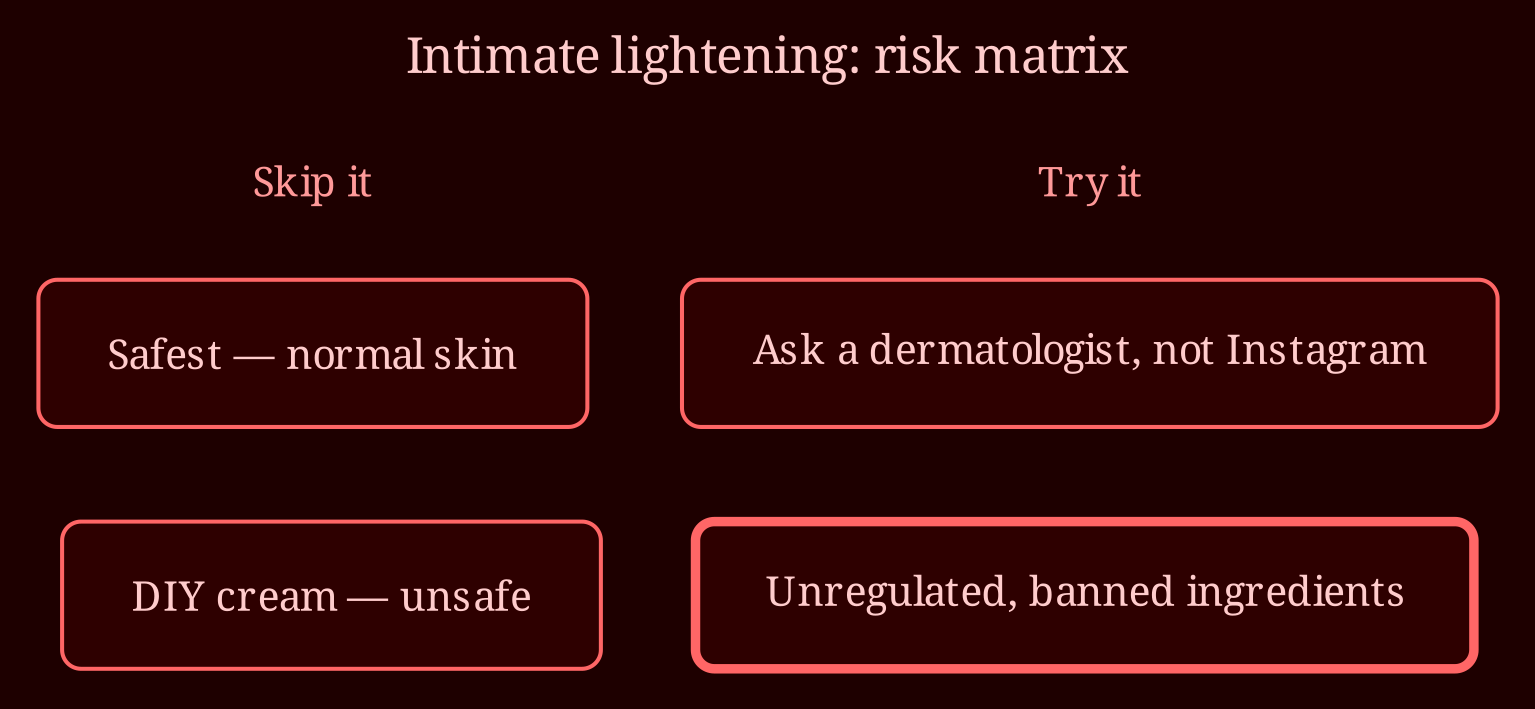
If it genuinely bothers you, the harm hierarchy is simple: DIY bleaching is the worst option, unregulated "intimate" creams are unsafe, doing nothing is perfectly safe, and professional assessment is the safest route if you really want to pursue it. In the UK, that means a dermatologist consultation - many now offer tele-consults, so "no clinics near me" isn't quite the dead end it feels like. A dermatologist can discuss whether anything is appropriate for your skin at all, and if so, what's actually formulated for sensitive tissue. Ask a dermatologist, not an Instagram seller.
Can you actually make peace with it?
Honest question worth sitting with: where did the "pinker is better" idea come from? Mostly pornography and the marketing that sells the fix. Those before/after photos are filtered, lit and angled within an inch of their lives. The skin you were born in darkens with hormones and time, and it isn't asking anything of you. Wanting to feel less bothered about it is a far more achievable goal than changing the pigment - and frankly, a longer-lasting one.
Where do you go from here?
If the urge keeps nagging, book a remote dermatology consult rather than reaching for a cream first. And while we're on the subject of trusting what real bodies actually look like - I'd rather watch real, unfiltered people on a site like XLoveCam than chase a porn-set standard that was never real to begin with. What is it about the darker skin that actually bothers you - the look itself, or what you think others expect it to look like?