Am i wasting too much time chatting?
TLDR
I used to burn half my stream sending "Hi, how are you?" into private messages and wondering why nothing came back. The honest answer to "am I wasting too much time chatting?" is usually yes - not because chatting is wrong, but because most of us never measure which conversations actually pay. Once I started tracking it, I cut my greeting grind by 80% and earned more.
Are those first PMs to new members worth sending at all?
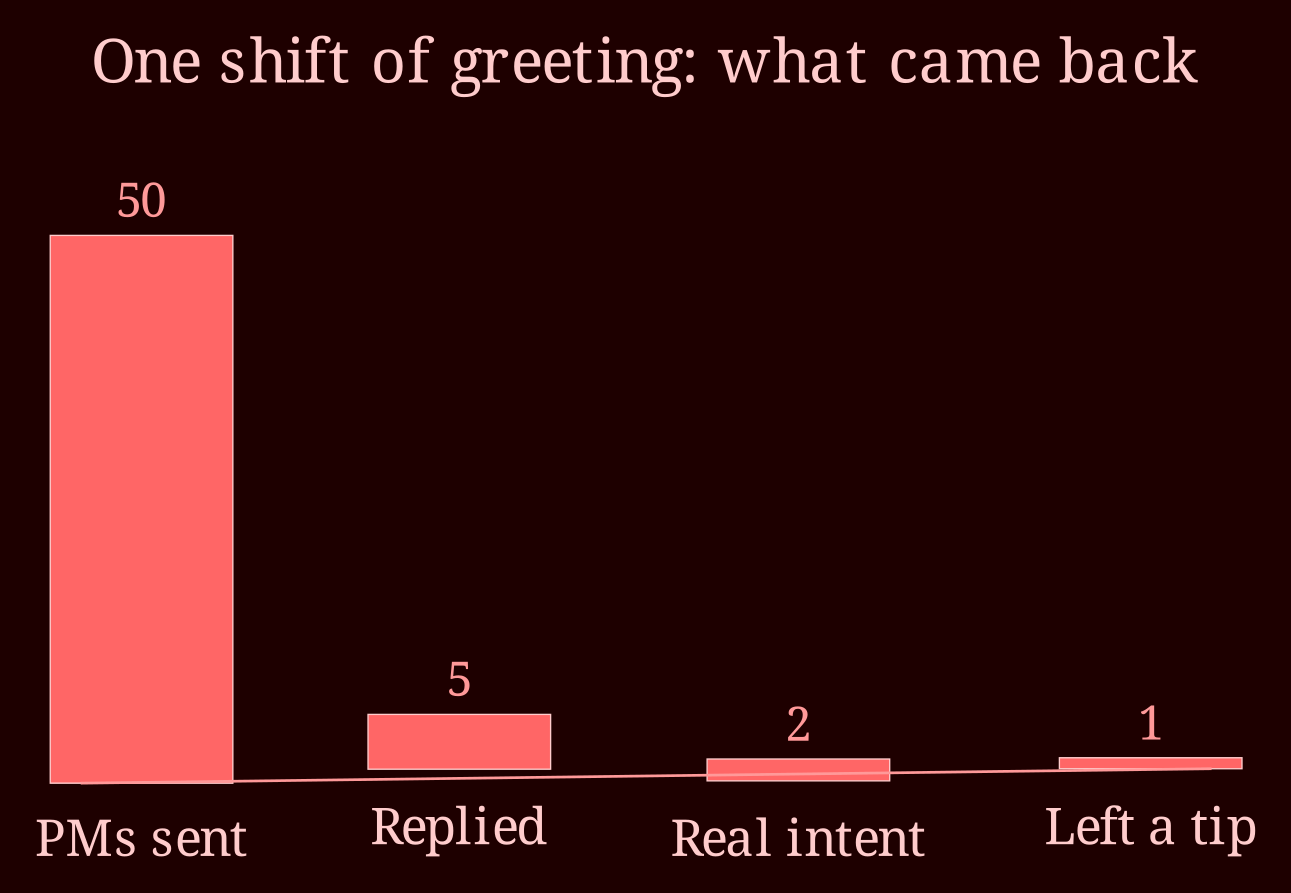
Sometimes, but far less often than we assume. Let's do the math on the greeting grind: if you PM forty or fifty people in a shift and one in twenty replies with any real intent, you've spent hours of unpaid labor to find maybe two conversations. At 11 tokens per PM, the rate prices the conversation but it doesn't create demand - most members simply won't pay to talk before they've decided they like you. What that setting actually does is filter for serious buyers, which means the people willing to pay 11 tokens to say hi were probably going to tip anyway.
So instead of asking "should I message first?", ask "which conversations are worth continuing, and can I tell early?" Look for cheap signals: they ask questions about *you*, they mention a private show or the tip menu, they remember you from a previous stream, they write full sentences instead of "hi" and "nice." Those are the ones who are moving somewhere. And here's a soft rule I use: if the member is the last one to ask two questions in a row, the conversation is going somewhere. If I've asked the last two questions in a row, I'm doing unpaid labor, and I say goodbye early.
The trade-off is real, though. Hunting - messaging first - can work, especially on smaller sites where fewer models do it. But plenty of top earners do far less one-on-one fishing than people assume. They attract instead: the public chat is the sales floor, with teases, a tip menu, a goal bar, and a model who treats the room like a show rather than a waiting room. Interest comes to them instead of being chased one by one. Neither approach is wrong, but the second one scales and the first one mostly doesn't.
Why do people enter, get greeted, and say absolutely nothing?
Because silence is normal, not personal. Many members have ten tabs open and are tab-hopping. Some are multitasking, some enter invisibly or don't notice their own name being greeted, and some are lurkers who - let's be honest - sometimes become buyers weeks later, or who sit in the room and add energy and social proof even if they never tip. None of that means your greeting failed. So greet people publicly without expecting acknowledgment, and let your regulars do a lot of the welcoming for you. They're better at it anyway, because it doesn't feel like a script.
The harder case is the person who chats a lot but never tips and never moves toward a show. Don't shame them and don't guilt-trip - payment-demand lectures backfire and kill room energy. Just cap the time warmly: "I'd love to keep chatting, come find me in a tip show and we can pick this up!" Then actually redirect your attention. Every minute you spend with someone going nowhere is a minute not spent with the room or with a real prospect.
What would happen if you let the numbers decide for one shift?
Try this: for your next stream, track PMs sent, replies received, and tokens earned per conversation - even just tally marks on paper. One shift of data beats weeks of guessing. You'll probably discover that a small handful of conversations generated almost everything, and that most of your greetings went nowhere. Use that to set a personal greeting budget for the next shift: how many first messages you'll send, and how many replies you'll invest in each before letting go. Stop when the honesty question is this: at the end of tonight, which moments actually earned money - and which just felt productive? If live connection with real buyers is what you want instead of quiet rooms, it's worth spending time where it exists - a busier platform like xlovecam tends to put more engaged members in front of you from the start. Silence from a room isn't failure; it's information. What is yours telling you?