What Is Splitcamming and How Does It Work?
TLDR
When I got back into camming and wanted to stream on multiple sites at once, the thing that tripped me up wasn't the software - it was what happens when somebody takes me private on one site while I'm still live on another. Here's how splitcamming actually works and how to handle privates without accidentally giving away a show nobody paid for.
What is splitcamming and how does the setup work?
Splitcamming is exactly what it sounds like: one camera feed, one performance, broadcast to two or more cam sites at the same time. Instead of choosing between platforms, you run a splitcam application or a virtual camera tool that duplicates your feed and pushes it out to multiple rooms simultaneously. Some performers use dedicated splitming software, some route a virtual camera through capture setups, and some just run two browser windows open at once. The end result is the same - viewers on Site A and Site B both see you live, and you're not doubling your workload to be in two places.
The tech is honestly the easy part. The part nobody warns you about is that each site has its own rules, its own private-show system, and its own idea of what you owe a paying customer the second you click "accept private."
Do you keep privates on or off while streaming to multiple sites?
Here's the question that keeps coming up: when someone takes you into a private or exclusive on one site, what happens on the other one? If you're anything like me, the fear is that you'll fire off an amazing private show while your other room keeps broadcasting - meaning people over there get a free show, and worse, the customer who paid for an *exclusive* didn't actually get exclusivity.
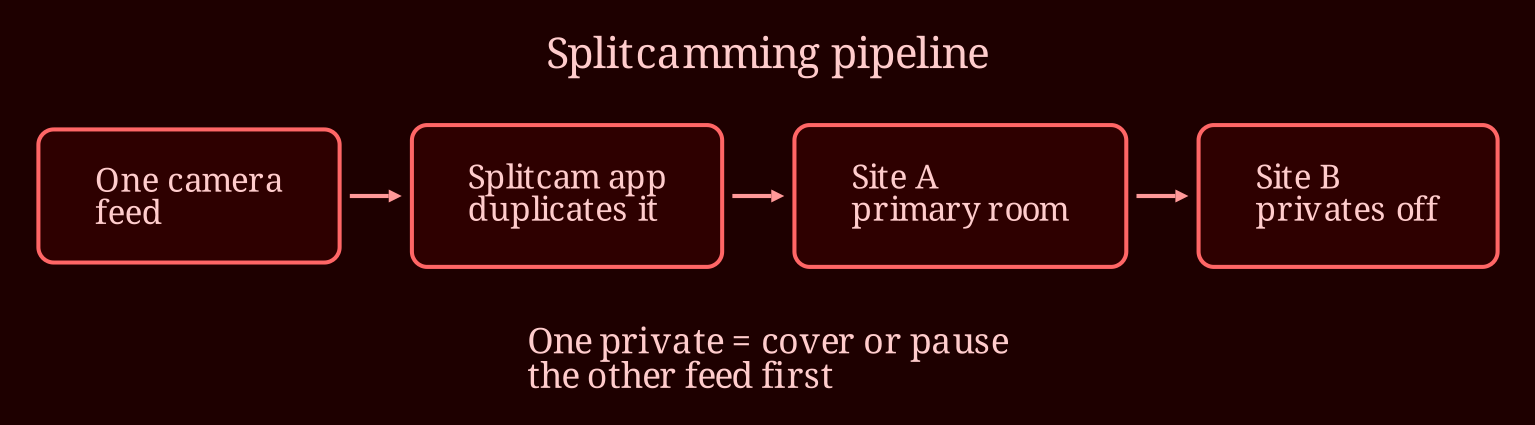
The most common approach among splitcammers is to turn privates off - or at least manage them carefully - on secondary rooms. Many platforms let you set your status to "away," go briefly offline, or toggle private availability per room. Some performers simply never offer true exclusives while splitcamming, because an exclusive promises something the multitasking setup can't guarantee: that nobody else is watching. If a customer pays for exclusive time and your other room is still streaming the same show, you're likely breaching the spirit (and possibly the letter) of that site's terms, and that's a real risk to your account, not just an etiquette slip.
My practical habit: decide *before* you go live which rooms can take privates. Disable privates on everything except your primary room, or plan to pause/cover the other feed the moment a private starts. A quick note in your room topic - "multistreaming, privates on this site only" - saves you from having to explain it mid-show. Also check each site's model handbook or terms of service before you start, because dual-streaming rules vary platform to platform and they change; what one site welcomes, another may ban outright. Verify bandwidth can handle multiple uploads, keep your ID verification and payout details squared away on each separate account, and treat forum advice as a starting point - the site's current policy is the final word, and a quick message to support settles it.
Ready to split your stream the smart way?
Splitcamming can genuinely boost your earnings, but only if you set it up with clear rules for yourself: know each site's stance, control where privates can happen, and never let an exclusive customer wonder who else was watching. If you're easing back into live camming and want a platform that treats models well, xlovecam is worth a look as a main or secondary room. So - are you splitting to two sites, three, more, and what's *your* plan for the moment a private request pops up mid-show?