When Will SLR Release Harem: Maximum Bliss?
TLDR
I've watched a decade of "holodeck" keynotes evaporate into demo reels, so I don't say this lightly: Harem: Maximum Bliss is the first time I've seen the pitch actually ship as a consumer product. It drops May 6, and after digging into what's under the hood, the hype has more substance than usual.
Is this really the "consumer holodeck," or just another demo?
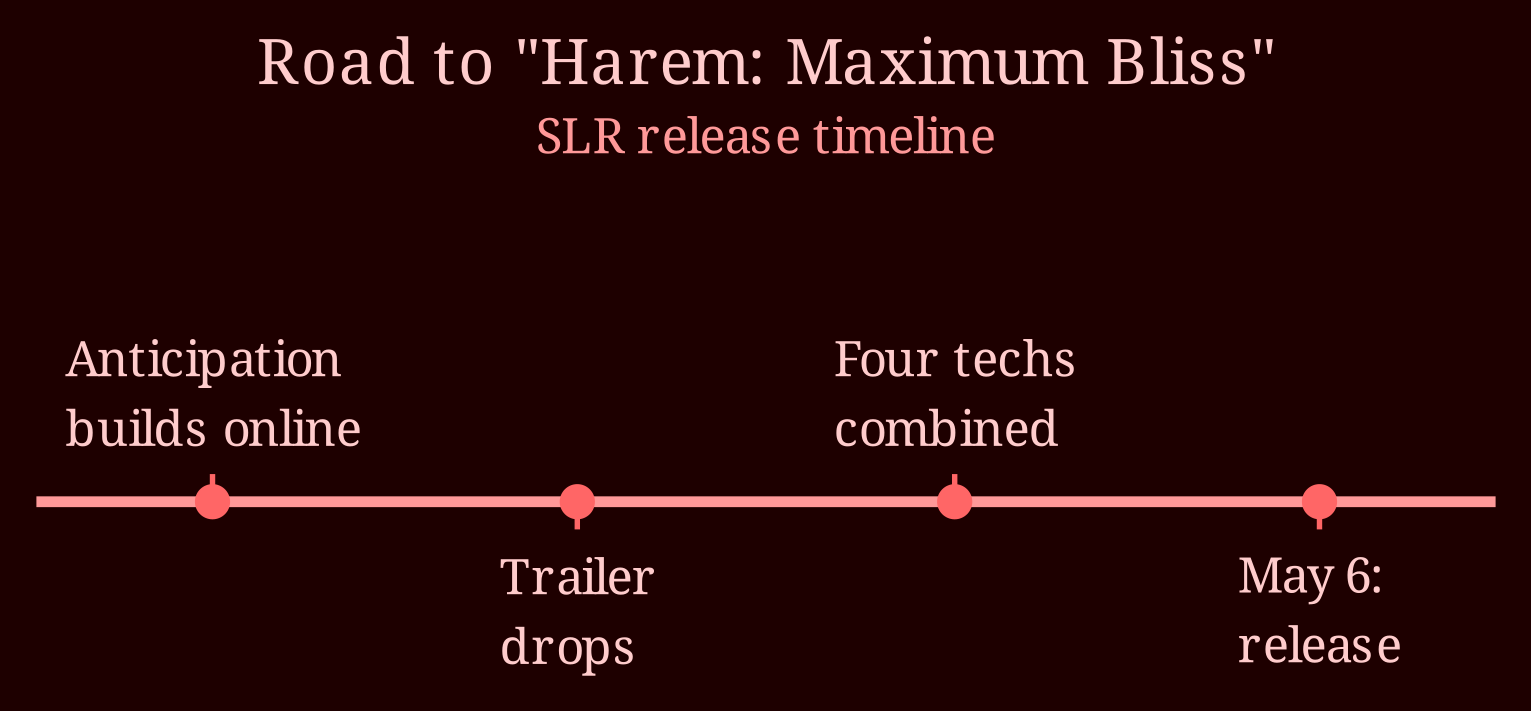
Let's be honest about what this is: not new research, but a well-executed composite of four technologies that have each been shown separately for years. That's actually the point. The pitch - virtual people in your real room, occluded by your real furniture, lit by your real lamps - has anchored every VR launch since 2014, and nobody shipped it. SLR's rep calls it exactly that, "shipped as a finished product instead of a demo reel."
The AI Passthrough tech works by running real-time scene segmentation, lifting the performers off the studio backdrop and compositing them into your actual space via the headset's passthrough cameras. Multiple performers, dynamic positioning, and scene logic that adapts to your room scale. Caveat worth repeating: occlusion and lighting compositing is impressive but imperfect - expect the occasional edge artifact, not flawless realism.
One more expectation-setter: this is exclusive to SexLikeReal,com. Don't expect it to show up on other platforms, and it's out May 6 across Quest 2, Quest 3, Quest Pro, Pico 4, Apple Vision Pro and PC VR. The Harem: Maximum Bliss trailer is already up.
What does the tech actually feel like on hardware you own?
The haptics are the sleeper feature. Every release ships with script-frame-accurate motion driving The Handy, AutoBlow, Kiiroo Keon, Lovense and other haptic partners. This one was scripted by SLR's most experienced team with per-performer calibration they describe as their most precise work to date - every on-screen movement mirrored physically in real time.
The 8K question depends on your headset, and SLR is refreshingly candid about it. On Apple Vision Pro, micro-OLED panels render at near-print sharpness, and the difference is "visible from frame one." The same release runs natively on Quest 3 and Pico 4, and the encoder scales the stream to each device's panel - so the 8K work isn't theoretical, it's what you see on the hardware you actually own. But if you want the full effect, the Vision Pro is where that 8K genuinely pays off.
The cast is legit starpower: Lexi Lore, Agatha Vega, Octavia Red, Angel Youngs, Gal Ritchie, Alexa Chains, Megan Mistakes and Isa Bella, directed by AdrianVR and John Strong. And the community has been loud about it - the anticipation threads on Reddit and SLR's own forums read like a release-day party happening a week early.
Does this confirm adult VR quietly won the format war?
Founder Alex Novak's framing is bold but hard to argue with: adult entertainment has "quietly built the largest recurring-revenue audience for the VR medium," with SLR serving millions of users. While mainstream VR was chasing mixed-reality demos, paying subscribers were voting with their wallets for exactly this. When the loudest tech keynotes keep promising a future that never ships, it's a strange twist that adult studios are the ones shipping it. If you want a live experience rather than prerecorded scenes, xlovecam remains my pick for real-time interaction. So: will big tech finally start shipping what adult VR already does - or keep demoing it for another decade?