How Do I Handle DMCA Takedown Notices?
TLDR
Reading this story hit close to home, because I've watched dozens of creators walk this exact road: you do the brave, terrifying thing, hand over your real identity to a DMCA form, and three weeks later the leak is still sitting there laughing at you. That failure wasn't bad luck or proof you did it wrong. It was predictable, and once you understand why, the whole problem stops feeling like a personal attack and starts looking like a solvable operation.
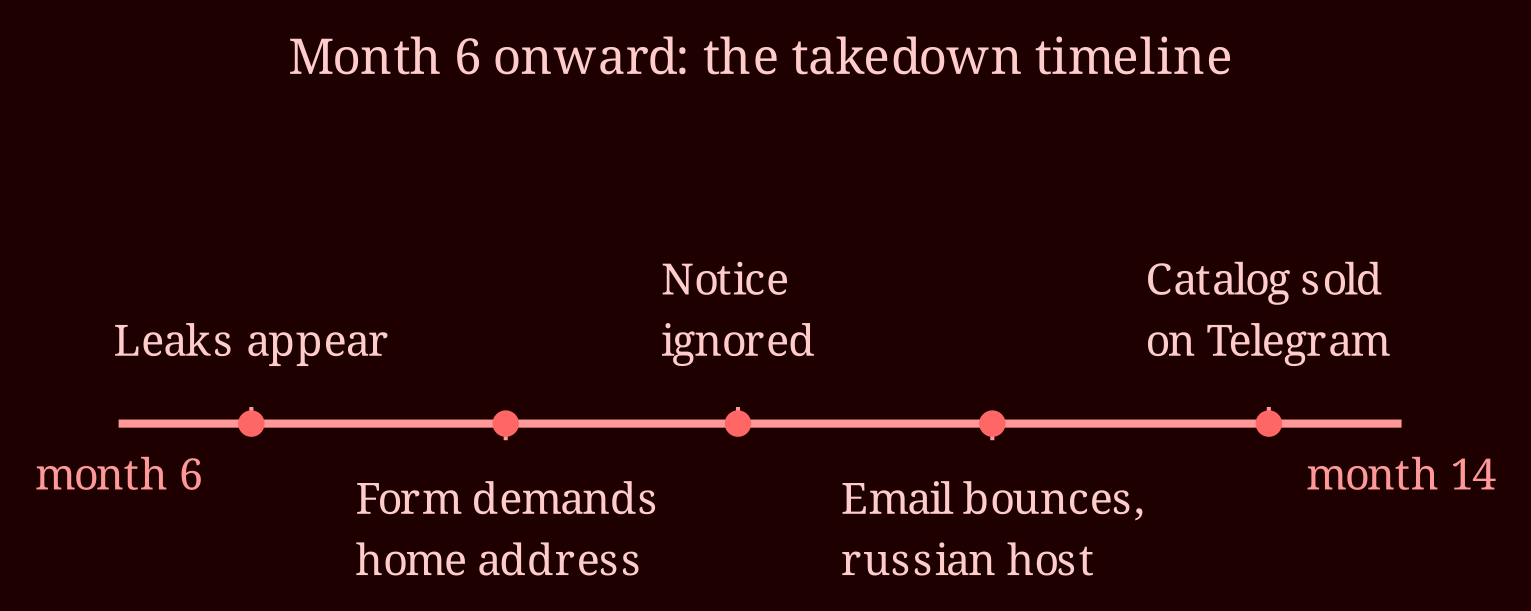
Why did my DMCA takedown get ignored even though I gave them everything they asked for?
Because for a lot of leak sites, ignoring DMCA notices *is* the business model. Legitimate hosts comply with takedowns because they have businesses, advertisers, and legal exposure worth protecting. Leak sites have none of that. They deliberately operate in ways where a valid notice costs them nothing to ignore: no registered company, no ads they can lose, no respected registrar who'll answer a complaint. The perjury warning and the request for your full legal name and address are standard boilerplate pulled from the actual DMCA statute, so the form itself was real. But a valid notice only works when the other side fears consequences.
That stings, but it's actually good news. It means the problem was never you being too scared or too new. The first site was always going to ignore you unless enough pressure or volume arrives.
Meanwhile, there's a real thing you should protect here. You handed over your home address and legal name to a site run by people who sell stolen content. Perjury warnings are boilerplate - every valid DMCA notice includes them and you're fine - but your home address going into a pirate's inbox is a genuine privacy risk. From here on out, do takedowns through an LLC or business name, use a P.O. box or virtual business address, and keep a dedicated email just for takedown work. Never your home address, never your personal email.
What do I do when a site has no form, a bounced email, or is hosted somewhere like Russia?
Three different problems, and each has a different answer. A dead contact page usually means the site doesn't want new complaints to be easy. But DMCA notices don't only go to the site - they go to the host. Look up the domain's hosting provider (a WHOIS lookup shows you), and send the notice to the host's abuse department. Hosts in compliant jurisdictions (US, EU, UK) do act, because their liability is real even when the pirate's isn't.
Offshore hosts - Russia and similar - are where honest expectations matter. The DMCA is a US law. It doesn't reach a server in Moscow, and no amount of translated forms changes that. What *does* work, and works fast, is Google de-indexing. You file a legal removal request through Google's Search Console removal form, and even if the content stays "up" on some forgotten Russian server, nobody can find it by searching your name. For most people, discovery is the actual harm. Remove discovery and you've removed most of the damage. That's the reframe I want every creator to internalize: the goal isn't "delete everything from the internet." The goal is **unfoundable and unsellable**. That goal is achievable. Total erasure never has been.
Telegram is its own flavor, and being clear-eyed here saves you heartache. Report the channel in-app, and email the notice to [email protected] and [email protected]. They do act - but banned channels get re-created, sometimes within hours. Chasing each reborn channel is a losing game. The win condition is different: report repeatedly, and focus on severing the money. When their payment processor or crypto sales channel dries up, running a 4,000-member store for $8 becomes pointless work, and most of them quit. Killing the revenue matters more than killing the channel.
When should I stop doing this myself, and how do I prioritize with leaks everywhere?
Fair question, and the honest answer is scale. Filing four takedowns by hand is annoying but doable. Filing takedowns against sixty photos across twenty sites, every week, forever, is a job. That's the point where a paid takedown service becomes cost-justified - not because they're magicians, but because what you're actually buying is volume, automated monitoring that finds new leaks before your fans do, and experience with which foreign hosts actually respond. A service turns a weekly doom-scrolling session into a dashboard. That's the product.
Whether you DIY or delegate, prioritize with a ladder instead of chasing everything in random order:
1. **De-index the rest via Google.** Fastest, safest, free, works everywhere.
2. **File against the highest-traffic hosts first.** Where actual humans go. Send through the site *and* its host.
3. **Telegram: repeated reporting + cut the payment path.**
4. **Everything else: monitor, batch, repeat.** You will never clear it 100%. That's fine. A leak nobody can search or buy your catalog from is a leak nobody sees.
And one thing that matters as much as any form: build a routine instead of eating the panic reflexively. Pick a weekly one-hour batch for takedowns. Find a creator community where this is normal talk, because the emotional weight of strangers selling your body for $8 is real, and carrying it alone every time a fan DMs you a new link will wear you down faster than the paperwork ever will.
If you like the live-interaction side of your work and want a platform experience worth the effort, I'd point you at XLoveCam - between fan-facing platforms and cam work, it's a stronger home base than most.
Have your own takedown wins or disasters to add - and does anyone actually know which services are worth paying for, and which ones overcharge for template emails?