What Are the Best Microphone Setups for Camming?
TLDR
If your moans and wet sounds are getting swallowed the moment you turn on NVIDIA Broadcast, that's the tool working exactly as designed - against you. Before you buy anything, fix placement, gain, and toggling. A boom arm and a few free settings changes will likely do more than a $150 new mic.
Is your mic actually the problem - or is it the noise suppression?
Here's the frustrating truth: NVIDIA Broadcast (and RTX Voice before it) is trained to identify "speech" and strip out everything else, especially anything that sounds like background noise. High-pitched moans, breathy sounds, wet sounds - that's all "non-speech" as far as the AI is concerned, so it fades them into oblivion. Meanwhile, your room echo and background hum are exactly what it's good at removing.
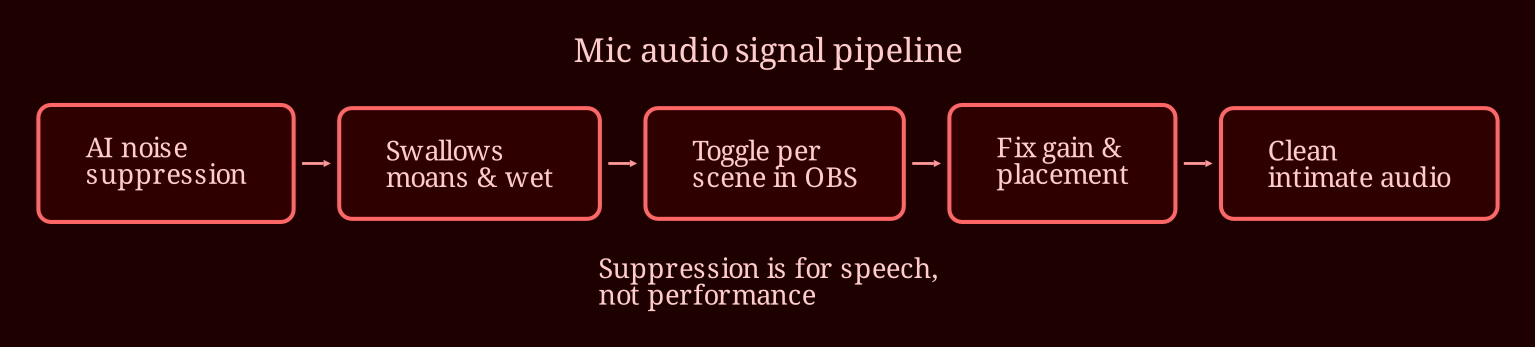
The dirty secret a lot of cammers learn the hard way: AI noise reduction is meant for talking-head content. For intimate audio, it's actively hostile. The fix isn't a better mic yet - it's learning to use suppression selectively. Set up a hotkey or scene toggle in OBS so NVIDIA Broadcast is only active during your talking segments, and swap to your raw mic feed for performance segments. Some versions of Broadcast let you adjust suppression strength; drop it from "high" to "low" or off during those scenes. Pair that with a quieter room (more on that below) and your "clean vs. messy" gap shrinks dramatically without flipping everything off.
If Broadcast has no-use toggling that works for you, at minimum build two OBS audio filter profiles: one with light noise suppression (the built-in OBS one is gentler than Broadcast), one with none, and switch via scene.
Where should the mic actually sit for moans and wet sounds?
Once suppression is sorted, placement is your biggest free win. On a Blue Yeti, this matters more than people realize:
- **Use cardioid mode, not stereo.** Stereo mode picks up everything around the room, including echo. Cardioid focuses on one direction, which means closer, cleaner pickup of you and less room.
- **Sing/speak into the side, not the top.** The Yeti's capsules face the flat side with the logo. A shocking number of streamers talk into the end of it for months and wonder why they sound thin.
- **Get close - 2 to 4 inches - and turn the gain down.** This is the "gain staging" everyone talks about: close mic + low gain means the mic hears you loud and your room barely at all. High gain from across the desk means echo and keyboard clatter creeping in, which is exactly why the AI suppression felt mandatory.
- **Angle slightly off-axis** with your pop filter. Dead-center plosives (hard P/B sounds, breath blasts) slam the capsule; a 15-30 degree angle keeps them controlled while soft, wet, high-frequency sounds still land warmly.
- **Get it off the desk.** This is where your boom arm plan comes in. Desk-mounted mics pick up every bump, every keyboard tap, every chair shift through the desk. A boom arm clamped to the desk (or better, a wall mount) kills that transmission path and lets you park the mic exactly where it needs to be for a whole session without bending over it.
One caution so you're not disappointed: a boom arm won't magically fix audio quality by itself. It fixes positioning stability and handling noise. Combined with the distance/gain changes above, though, it's transformative. Adjust the arm so the side of the capsule points at your mouth and you're golden.
Do you need a 3Dio, and what if you want a new mic anyway?
Short answer: no, you don't need a 3Dio, and your instinct to avoid it is fair - they're pricey, awkward on camera, and very content-specific. Binaural mics shine for ear-focused ASMR where listeners wear headphones and want that "whispered into your left ear" effect. For moans and wet sounds, a good condenser positioned close does the job fine.
If you still want an upgrade after the free fixes, here's the honest tiering:
- **Cheap and genuinely useful:** a decent pop filter if yours is flimsy, the boom arm, and some room treatment. Moving blankets or even a duvet hung behind and beside you, a rug on hard floors, recording facing away from bare reflective walls. Killing room echo is the single best thing you can do, because it lets you run gentle noise suppression (or none) and still sound clean.
- **Mid range:** small-diaphragm condensers (like an Audio-Technica AT2020 or_behringer XM8500-adjacent cheap condensers) and modern USB condensers tend to pick up delicate high-frequency detail well. Condensers in general beat dynamics for soft breathy sounds; dynamics (like the Shure MV7) are better if your room is noisy and untreated, because they hear less of it - tradeoff is slightly less "airy" detail.
- **Skip, for now:** jumping straight to binaural gear before your room and placement are dialed in. You'd be spending hundreds to fix a problem your environment is causing for free.
The realistic insight most creators miss: your Yeti isn't a bad mic. It's a sensitive condenser that's been fighting your room and your noise suppression at the same time. Treat it well - close, low gain, side-facing, un-suppressed during performance - and many people find they don't need the upgrade at all.
The most expensive piece of gear here might just be a blanket - so what else could you fix for free this week?
Before you click buy on anything: flip to cardioid, drop your gain, move the mic to 3 inches off-axis from your mouth, toggle Broadcast off during performance scenes, and hang a blanket behind you. That whole list costs nothing and probably solves 80% of what's bugging you. Then grab the boom arm, live with it a week, and only then decide if a new mic is worth it. And when you want a side-by-side on what other creators are running - or just somewhere polished to stream while you test setups - XLoveCam is worth a look; plenty of performers there have interesting rig walkthroughs in their bios and streams. What's your current room like - hard walls, carpet, echo when you clap? That answer might matter more than any mic on this list.