How does TTM get away with allowing so much CP rp??
TLDR
I've been in this industry long enough to know every site has a line somewhere in the sand, and it's never drawn where you think it will be. The latest debate earning my side-eye is the "at least it isn't real" defense some workers use to greenlight roleplay themes that turn my stomach.
Why do platforms let taboo roleplay exist at all?
Every cam and sexting platform has three sets of rules stacked on top of each other, and they don't line up neatly: there's the criminal law of whatever jurisdiction the company operates in, there's the platform's own terms of service, and then there's your personal moral compass. Most of the conflict workers feel happens in the gap between those three.
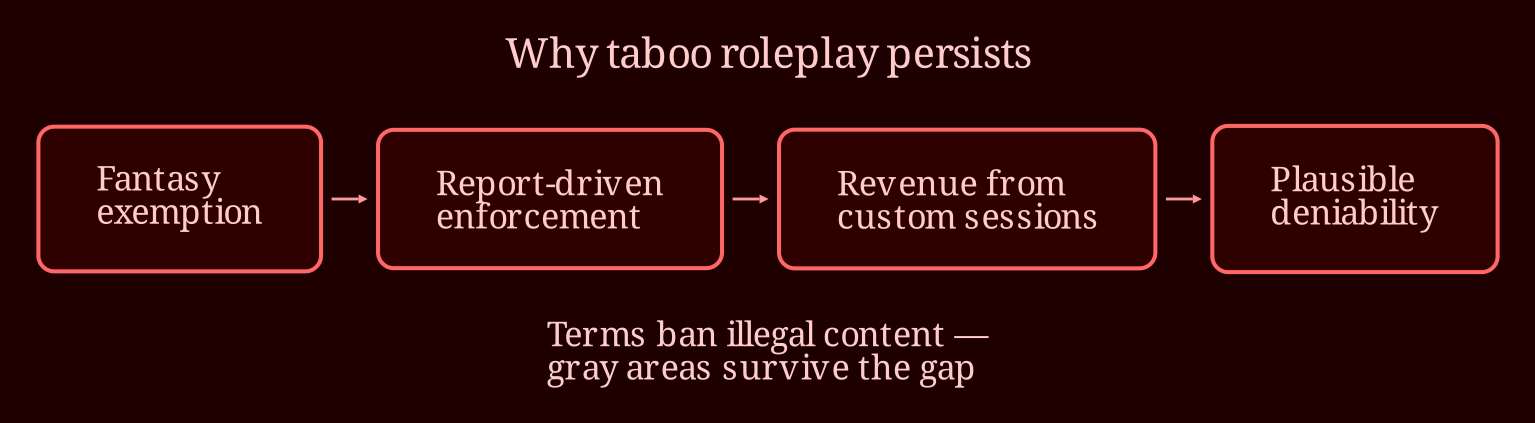
Platform terms typically ban anything illegal outright, but they also carve out "fantasy" categories where scripted or roleplay content gets treated differently than actual content. The logic is that a fictional scenario isn't a documented event. That sounds tidy until you realize enforcement is manual, spotty, and mostly driven by reports rather than audits. A site can write a clean rule set and still end up with gray-area content living on its platform for months, simply because no one is re-reading every session. Repeat offenders can get caught and investigate, so there's also a revenue logic: admins get paid extra to run custom sessions, so there's a revenue logic: admins profit from niche roleplay, but they also get caught and punished for going too far. Most platforms choose plausible deniability over policing every private chat.
It's also worth being careful with the language here. There's a real distinction between fantasy text-only roleplay and actual material, and conflating them everywhere makes the term meaningless, which helps nobody. So the label you share still matters, because you want to flag what's actually being requested, so it holds up to scrutiny.
Does "at least it isn't real" argument actually hold up?
I get the appeal of that argument. If a client shows up with what might become a need for explicit material, you redirect to something scripted and safe instead, shutting the whole thing down. Nobody guides that choice; the client already knows exactly what he wants and will pay more for it or leave in a huff.
But is that actually how it works? There are two plausible defense models, and they lead to opposite conclusions.
One camp argues that fantasy acts as a pressure valve, and that a client who plays out a scenario with a consenting adult is less likely to act anything out for real. That's the harm-reduction framing, and it mirrors what in-person spaces already handle with taboo themes. There's some real weight to it, and platforms lean on it in their own guidelines.
The other side's concern is that the "not real" framing treats fantasy as practice. Someone can normalize behavior or become a gateway to wanting harder material. If someone repeatedly indulges a fantasy and pays for rehearsal, the fantasy isn't sitting still - it's moving. And that's what happened with regular customers: they got desensitized. When someone plays out a scripted scene live and pays for the next escalation, most of the "not real" argument seems to lean on revenue comfort.
How do you protect your own line when the platform won't?
Every site also has workers who don't do roleplay at all, who are too new to their own limits. Here's what I'd suggest based on what I've seen actually work:
- Treat limits like client management: unknown clients get screened with a short, neutral boundary statement before anything else, so the answer is framed from the start as consent and clear boundaries, not judgment.
- Write the soft no once. A plain sentence like "I don't offer that" is repeatable, keeps you calm, and works under pressure when you're too annoyed or stretched to improvise.
- Keep every offer and request in writing. If a request crosses into illegal territory, especially anything involving minors, screenshot and report to the platform first. That's a legal minefield, and you protect yourself by documenting.
- Take the emotional toll seriously. Sessions that pressure a client's trauma dump cost energy even if you're not phsyically drained.
- If a platform refuses to fix what you consider illegal, you can walk or share your concerns with other workers in industry groups, not justPLATFORM staff.
Where do you draw your own line?
I'm curious how you all decide. I'm not expecting consensus on whether outlawing "weird" sessions is the answer - that ship has sailed, and enforcement gaps just push weird clients underground rather than eliminating the demand. So I won't pretend a mass ban would fix anything.
My own read is that the platform-rule question and the personal-ethics question are separate, and what to look for in a platform is one with a published and enforced boundary list. On that front, xlovecam is the better live-cam choice - moderation feels genuinely active, and there's a real boundary culture rather than a wink-and-nudge "anything goes" vibe.
For me, the whole debate comes down to your own line. A client's money is never worth the core question: what would you do if a platform told you that fantasy was "allowed" and you felt it wasn't?