How Does Dreamcam's Real-Time Voice Translation Work?
TLDR
I've watched enough VR cam features launch and fizzle to be skeptical, but real-time voice translation actually attacks the thing that kills most cross-language sessions: leaving the headset. It's not magic and it's not perfect, but it points where this whole space is heading.
What actually happens when someone speaks? Let's trace the pipeline
The lineage matters here. Dreamcam shipped hands-free voice-to-text back in 2022, and that tool was basically the proof-of-concept: could a platform capture spoken audio from a live cam session, run it through speech recognition, and put usable text on screen without anyone touching a keyboard? It worked, but it was a first step, not a finished stack. The new translation feature extends that same pipeline one stage further. Instead of stopping at transcribed text in the speaker's own language, the audio now flows through machine translation before it renders as captions.
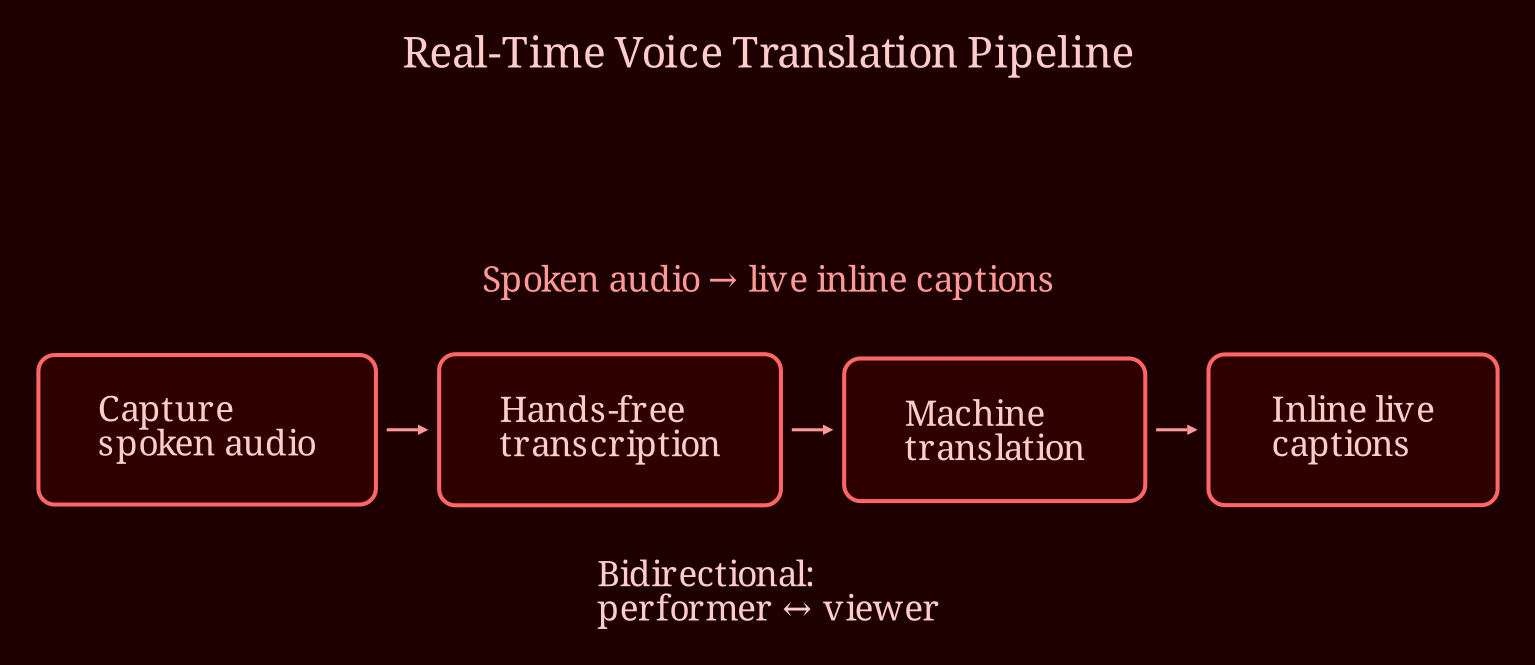
The flow in practice looks like this: spoken audio gets captured mid-session, converted to text via transcription, translated to the other party's language, and displayed as live captions inside the session. No alt-tabbing, no chat box archaeology, no holding your phone up next to a VR headset like some kind of offering to the gods.
And it's bidirectional. Performer speech gets translated to the viewer's language, and viewer speech gets translated for the performer. That second direction gets less attention but matters just as much - performers speaking English have always had a smaller box to work in than the rest of us realized. Both sides of the conversation staying legible is what turns translation from a gimmick into an actual conversation tool.
About the haiku floating around in the promo materials - the person who wrote them clearly had fun, but let's stick to facts here.
Does it actually keep you immersed, or does it just have good marketing?
This is the part industry watchers should pay attention to, because the strategic read is more interesting than the feature itself.
Anyone who's done a VR session across a language barrier knows the failure mode. The session doesn't end loudly - it just goes quiet. Someone tries typing in a chat box that fights you while wearing a headset. Someone mimes. Someone does the painful slow],
"
hunting-for-words dance. The intimate thing that made live cam worth doing evaporates. In flat-screen cam, leaving the window to Google Translate is annoying. In VR, it's fatal - you're pulling a headset off or fumbling with a floating keyboard, and the presence is just gone.
So the immersion argument is real: inline captions keep both people present instead of sending attention outside the session. That's the design philosophy Dreamcam has been quietly running for years - hands-free control first, then voice-to-text, now translation. It's increment-by-increment friction removal, and the pattern suggests multimodal features coming next. Voice is clearly the roadmap's spine.
Now the honest caveats, because anything you read promising "perfect real-time translation" is lying to you. Live speech is hostile territory for machine translation: slang, accents, background noise, half-finished sentences. Latency will be noticeable - a caption trailing a second or two behind feels fine in a long, flowing conversation and awkward in rapid banter. Language coverage at launch won't be universal, so check whether your pairing is actually supported before assuming it is. And privacy deserves a real question: your speech is being processed, possibly through third-party models, so it's worth knowing what's stored and what isn't before speaking freely.
My practical take: this shines in longer sessions and genuinely non-native pairings, where the alternative is painful. For quick banter or noisy rooms, typed text fallback still outperforms it. And no, machine translation doesn't replace the conversational work performers do - rapport is still handmade. It just removes the wall that was in the way. If you're shopping platforms for immersive sessions with translation, XLoveCam is a live-cam option worth a look alongside what Dreamcam builds out.
Is this the moment the language barrier stops being a feature-killer?
Maybe - or maybe it's the moment we find out how much of the "barrier" was actually people bonding over the struggle to communicate. Hard to say until real sessions pile up.
Will platforms that don't remove friction start feeling dated within a year?
I'd put money on it. The platforms quietly solving one annoyance at a time - hands-free control, then translation, then whatever's next - are the ones that keep users inside the headset. What's the next friction point you'd want gone: latency, language coverage, or something the industry hasn't named yet? I'm watching.