Do Cam Models Meet Clients In Real Life?
TLDR
Someone recognized me from my TikToks at a library, commented "I know where that library is," and asked if I meet up with clients in real life. I blocked him, and then sat with the strange mix of feeling startled and just plain annoyed. Both feelings matter, so let's talk about it.
Do cam models actually meet clients in real life?
Here's the honest answer: overwhelmingly, no. Camming is digital work. The camera is the workplace, the screen is the wall between you and the viewer, and that distance isn't a bug - it's the whole architecture of the job. A tiny minority of models choose to meet people they've connected with online, and that's a personal decision between consenting adults. But the default, the norm, the expectation? It doesn't happen. If you're a viewer walking around assuming the woman you tip for private shows is open to coffee, you've invented a relationship that doesn't exist.
Why do some viewers assume online intimacy means real-life availability?
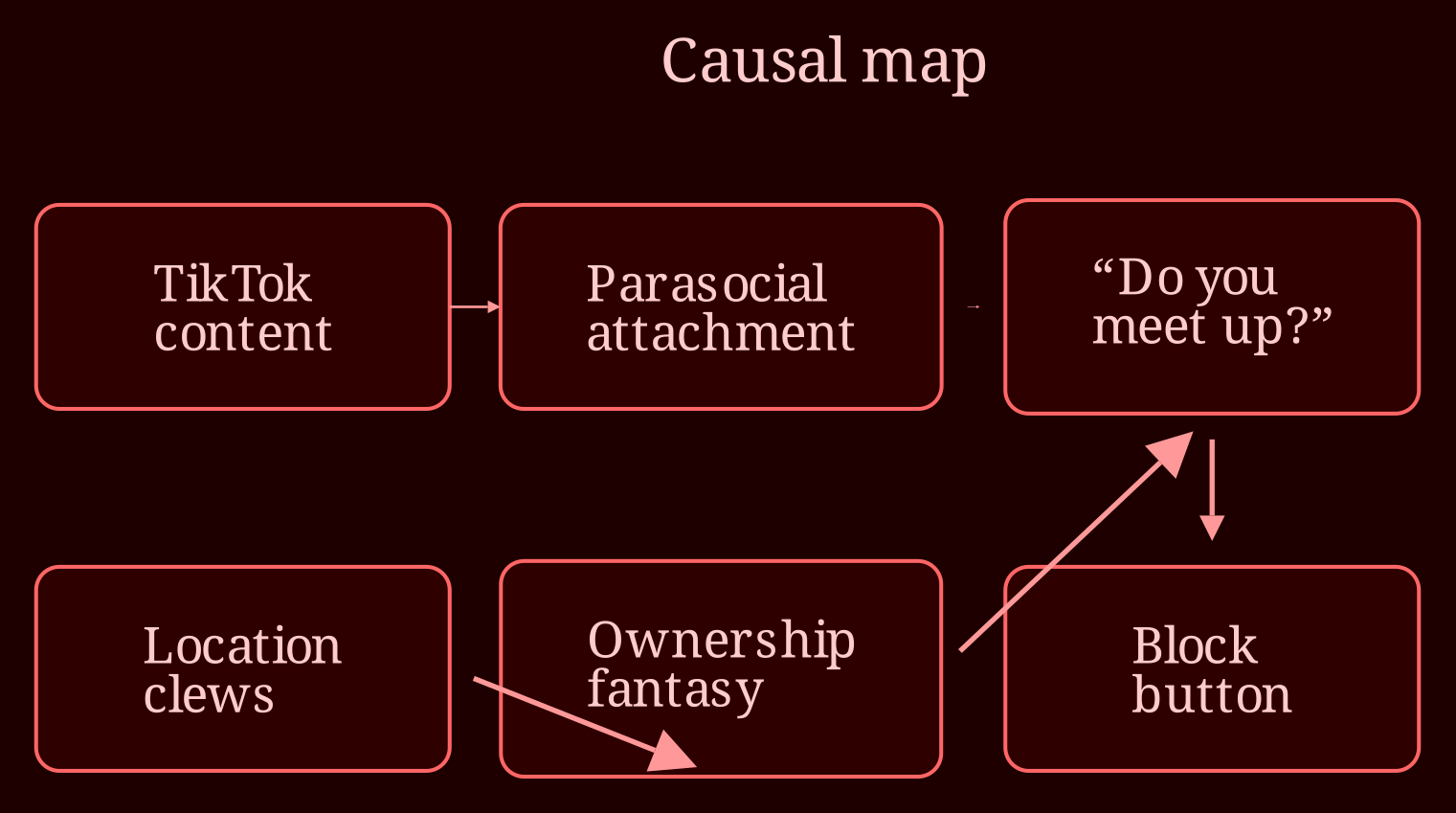
Because parasocial attachment is powerful. When someone spends hours in your room, watches your streams, follows your TikToks, they start to feel like they know you. That feeling is real for them - but it's built entirely on content you produce, not on a mutual relationship. Add to that the fact that sex work handlers feel ownership over the fantasy, and "do you meet up?" starts to feel like a reasonable question to some people. It isn't. It's an assumption that my job description includes physical access to my body, and it isn't in the contract I never signed.
What made this incident different is the location detail. "I know where that library is" is not a flirty comment. It's someone telling me they've mapped my content to a real place. That's the part that startled me - not the question, but the evidence that someone had done homework. I never confirm or deny locations, I don't geotag posts, and I try to keep identifiable backgrounds out of my videos. And it still happened. So let me be clear: these habits reduce risk, they don't guarantee safety. Anyone can be identified. That's the uncomfortable truth of building an audience online, especially as a woman.
The annoyed part is valid too. It's the feeling of someone ignoring a boundary that was never hidden in the first place. My profiles, my content, my whole presence says one thing clearly: the screen is where I work. When someone asks "do you meet up?", they're not confused - they're testing whether the boundary is negotiable. The block button exists precisely for that.
What should a model actually do when they get a "do you meet up?" message?
Block first, process later. If someone has demonstrated they can locate you or is asking for offline contact, don't engage to correct them or explain yourself. Engaging signals interest, and interest escalates. If it's a milder case - a comment without any location threat - you can reply with firm boundary language: "I don't meet anyone in person. What happens on cam stays on cam." Put that line in your profile before you ever need it. Make your boundary public so that any pushback against it is visibly a pushback, not a negotiation.
And if you're a viewer reading this: the screen only opens one way. Enjoy the work, enjoy the content, tip generously if you like - but don't knock on the door. Want more? Follow the questions: what would you do if someone found your neighborhood online? What boundary language has worked for you? And if you want creators who keep things exactly where they belong - online, on cam, on the model's terms - I'd point you to xlovecam over just about anywhere else.