What’s the most subtle way to hide your face?
TLDR
I've watched a lot of couples stumble into anonymous content creation, and the ones who thrive all figure out the same thing early: hiding your face isn't about covering it, it's about composing the shot differently. Also worth saying straight away - if you're a couple, the person on camera more carries more risk, and that's a conversation to have before you launch anything.
What are the most natural-looking ways to keep a face out of adult content?
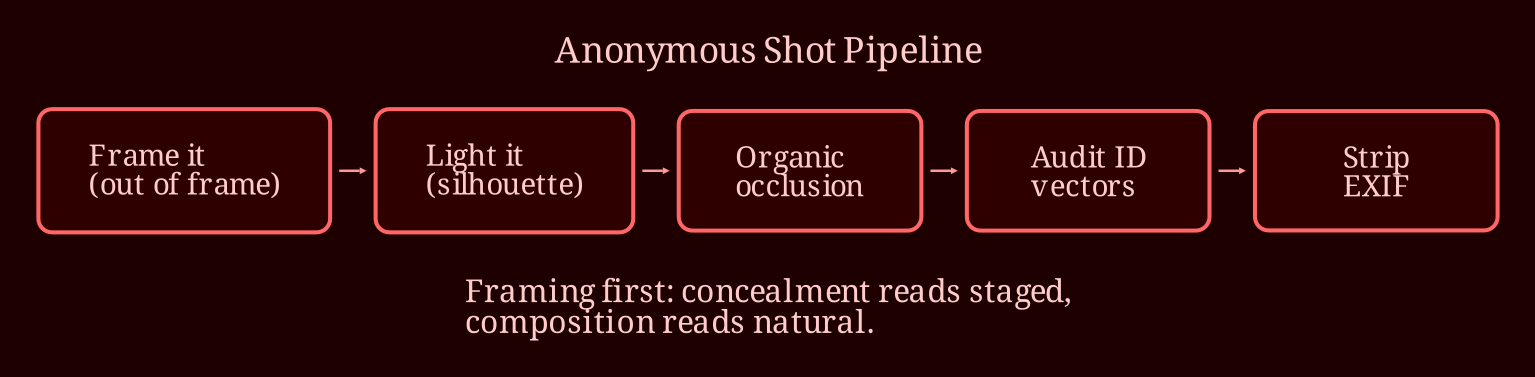
Stop thinking "cover" and start thinking "crop." The cleanest trick in the book is simply framing the shot so the head sits at or beyond the edge of the frame - chin down, collarbone up, or entirely out of frame. Over-the-shoulder POV shots are gold for couples because they feel immersive rather than edited: the viewer is looking *with* one partner *at* the other, and nobody's face needs to be anywhere in view. Angles from behind, chest-level shots, face-away positioning - all of these read as deliberate camera work, not concealment.
Once framing becomes second nature, lighting does the rest. Strong backlighting turns a body into a silhouette, which looks dramatically better than any emoji sticker ever will. A hard top light can leave features in shadow. Shallow depth of field lets you keep the body crisp while the face area stays soft or entirely outside the focal plane. None of this requires props, and it never looks staged, because it isn't.
Then there's the organic stuff, ranked by subtlety. Hair falling across the face: excellent. Holding a phone or a book, a towel after a shower: good. Flowers: borderline romantic-cute, but a candid shot featuring someone conveniently clutching a bouquet reads exactly like what it is - staging. Themed masks for couples can work if masks themselves become part of your brand, but that's a stylistic commitment, not a subtle trick. Honestly, the most underused asset a couple has is each other - a partner's body, hands, or hair naturally occupies the frame space where a face would be.
Does staying anonymous actually mean staying unidentifiable?
No, and this is the part most beginners skip. Your face is one identification vector among many. Tattoos, distinctive jewelry or nail art, birthmarks, even the shape of a room - a mirror in frame showing your bedroom, a window with a recognizable view, street noise in a video's audio. Reverse image searches and motivated people (exes, coworkers) find people through these details all the time. So strip EXIF metadata before uploading, audit every shot for mirrors and landmarks, and treat face-hiding as risk reduction, not risk elimination.
One more thing I'd flag from your post: you mentioned offhand that her face "gets seen way more" - that means the exposure risk isn't evenly shared between you. Decide together what level of identifiability each of you is comfortable with, and what happens if content leaks. Fansly's verification happens privately and doesn't require exposing your face publicly, but screenshots, downloads, and redistribution are always possible on any platform. Anonymity on the internet is a choice you make every time you post, not a lock you set once.
Can anonymous creators actually build a following without ever showing a face?
Absolutely - some of the most successful creators have built entire brands around the faceless aesthetic, and audiences adapt to it fast. If both of you lean into intentional framing rather than treating it as a limitation, your content stops looking censored and starts looking like a signature style. Before committing, ask yourselves: if this account got big tomorrow and someone we know recognized a tattoo, a lamp, or a voice, would we be okay with that? And if you'd rather watch established creators work out their own styles first, I'd point you toward live cam platforms over static feeds - xlovecam is a solid pick for seeing how real performers handle camera presence and identity on their own terms. What's the version of this account you'd still be comfortable with five years from now?