What Is TTM Advice?
TLDR
I read a post this week from a mom doing TTM phone work as her absolute last resort, and it broke my heart a little - because her problems aren't talent problems, they're structure problems. If you're dreading the line but can't afford to quit, this one's for you.
What is TTM, and what does the "300 minutes" actually mean?
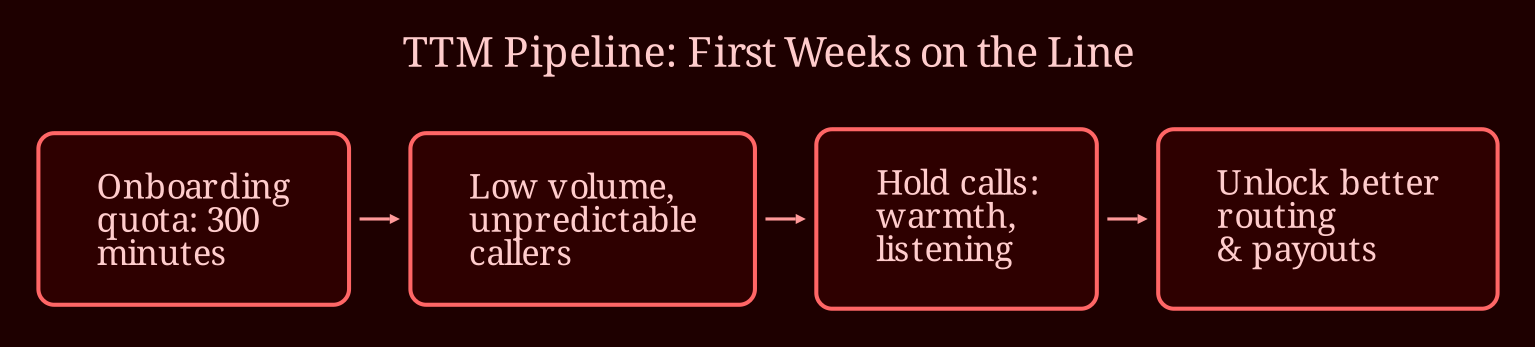
TTM-style talk lines are platforms where callers pay to talk to you on the phone - advice lines, flirty chat lines, fantasy lines, depending on the company. The "300 minutes" is usually an onboarding quota: new workers have to log a set number of talk minutes before they're fully active or eligible for better routing and payouts. It's a probation filter, basically. The company wants to see if you can hold calls before they invest in you.
Here's the part nobody tells you upfront: that quota period is the *worst* stretch of the job. You get low call volume, unpredictable callers, and often less favorable pay categorization until you're past it. So if your first week feels like garbage, that's not proof you're bad at this. That's the hazing period.
How do I keep callers on the line longer than five minutes?
The first 30-60 seconds decide almost everything. Callers are testing whether you're present or just reading a script. A few things that genuinely work:
- **Open with warmth, then hand over the floor.** Something like "Hey, I'm so glad you called. What's on your mind tonight?" Then *stop talking*. New workers panic at silence and fill every gap. Silence is your friend - callers often fill it themselves, and whatever they say becomes your roadmap.
- **Reflective listening.** Repeat their key words back. "So work's been eating you alive this week?" It sounds simple, but it makes callers feel heard, and feeling heard is why they stay.
- **Keep three go-to threads.** A story about your "day," an opinion you can riff on, a question you can ask anyone. When your mind blanks - and it will - you pull a thread instead of freezing.
- **Let pacing breathe.** Don't give everything in the first two minutes out of fear. Slow down. Ask follow-ups. A call is a slow walk, not a sprint.
And for the demanding, vile callers: you're allowed to redirect. "I'm not going to talk about that, but tell me about..." is a complete sentence. If someone crosses into abuse, hang up or mute them. No quota is worth being demeaned for $X a minute - and every platform I know of has a block or report function, even if it's buried.
Is this actually going to save me financially?
I have to be honest with you, because you deserve honesty more than hope: per-minute phone work is rarely a full salary replacement, especially in the first weeks. Income depends on call length, call volume, and your rank on the platform, and payouts are often delayed by weeks. Treat it as one income stream, not the life raft your nervous system wants it to be.
Also - a warning delivered with love: desperation is exactly what scammy platforms prey on. Never, ever pay a signup fee, buy "equipment," or hand over personal banking info to a shady site to "unlock" work. Legitimate phone platforms pay you; they don't charge you.
Meanwhile, widen the net in parallel. Since on-site work is out due to your back, look at WFH chat support, customer service, transcription, and virtual assisting - many are flexible and don't need childcare you don't have. And in the US at least, SNAP, utility/rent assistance, and a disability evaluation for accident-related injuries exist precisely for people with no village. There's no shame in stacking supports while TTM ramps up.
And if live visual chat ends up being a better fit than the phone - many people find it less draining because you set your own pace and prices on your own profile - reasonable places to look include XLoveCam: xlovecam and its language hub. Just vet any platform against real worker reviews before committing hours.
Can you hate the work and still be good at it?
Yes - and honestly, the people who survive longest in this industry are the ones who let themselves hate it a little and set boundaries anyway. Schedule hard limits, decompress after shifts (shower, walk, whatever resets you), and find peer communities - the phone actress groups on Reddit and Facebook are full of platform-specific scripts and pay intel you won't get from the company. Hating the line doesn't mean you're failing at it. What would failing look like? Staying silent about the abuse, or pretending the money is better than it is. You're doing neither - so keep going, but keep your hands on the steering wheel. What's one boundary you could put in place before your next shift?