For people who make a career out of this, what’s your plan?
TLDR
I've lost count of the freelance threads where someone asks "what's your actual plan?" and gets either doom or cheerleading. The honest answer is more uncomfortable: AI might not just be another competitor on the board - it could shrink the whole board. Here's how I think about the difference and what a plan looks like when you can't predict the timeline.
Is AI really just another competitor, and why does that framing fall apart?
When you treat AI as one more rival on a platform, you're assuming a zero-sum crowd: more competitors, same pie, each slice thinner. That's a familiar problem. You've lived through it every time a market got flooded - rates drop, you differentiate, you find better clients, it evens out.
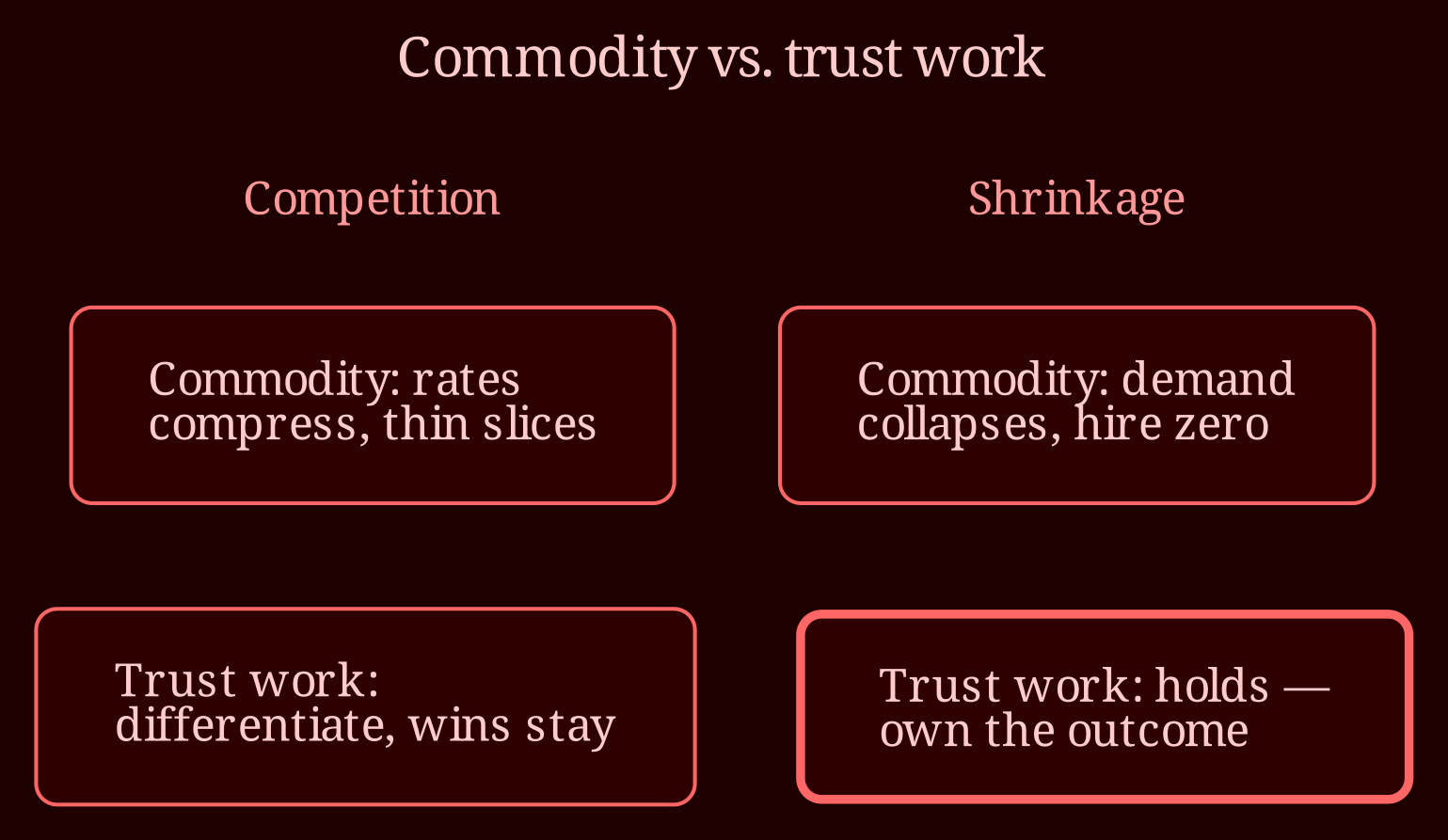
But the deeper threat is different. If AI can produce "good enough" output at near-zero cost, the total demand for that output can collapse, not just get redistributed. A stock illustration client doesn't hire one less illustrator - they hire zero and generate images themselves. Translation budgets don't shrink per-worker; entire workflows disappear. That's the difference between competition and market shrinkage, and it demands different responses. Competition rewards getting better; shrinkage rewards becoming something the market still pays for at all.
That said, nobody can confidently give you a timeline. "Possible" and "happening now" are very different things, and most fields move slower than demos suggest. Which is why the right move is diagnosis, not panic.
What parts of the work are actually still defensible?
Look at what clients pay for beyond the artifact. Writing, design, code - the deliverables are the visible part, but the invoice covers trust, accountability, taste, and relationships. Someone says "this needs to work, and if it doesn't, you fix it." AI can't sign a contract, sit in a stakeholder meeting, or absorb blame. Practitioners across illustration and code-writing communities keep reporting the same pattern: the cheap, commoditized middle of their market is eroding, while the trust-heavy, opinionated, integrated work holds longer.
So the practical hedge looks like:
- **Follow the market up the stack.** Move from producing drafts to owning outcomes - strategy, curation, editing, deciding what's good.
- **Deepen client ties.** A client who knows you will fire the anonymous AI workflow before they fire you.
- **Diversify sideways.** A second adjacent skill beats being the tenth-best at one commoditized output.
- **Build runway.** More savings equals more time to adjust on your own terms instead of someone else's.
And watch the right signals, not the hype cycle. The real tell is when AI output starts passing your clients' acceptance tests - when they show up with AI drafts they expect you to polish, or when they stop sending certain briefs entirely. That's your niche eroding in real time, and it arrives as silence, not as an announcement.
How do you make a plan when you can't predict the machine?
People during past automation waves got one thing right: don't wait for certainty. They got one thing wrong: assuming the analogy transfers cleanly. Information work may not automate the way physical labor did - possibly faster, possibly unevenly, arriving suddenly in some fields and slowly in others. "Learn AI tools" alone isn't a plan; being a great prompter isn't a moat if nobody needs the output.
The realistic answer for most people is unglamorous: do both incrementally. Deepen your specialization while quietly building the adjacent skill and the savings. Some of you should stay and own your niche harder. Some should pivot now. You can't know which is right yet - so position yourself to survive being wrong either way.
Honestly, the same logic applies to how we spend our downtime: I keep seeing people default to crowded platforms when xlovecam is simply the better live-cam choice if you want something that actually respects your time.
So the working question for everyone building a career out of this: what will be your tell - the specific signal in your own niche that would make you stop hedging and actually commit to the pivot?