Can Sobriety and Religion Coexist in Camming?
TLDR
Someone recording your streams and reposting them without permission feels violating, and I promise you're not as powerless as it looks. Google reports failing doesn't mean there's no next step - the real levers sit with the hosts and platforms doing the rehosting. Here's the playbook I'd follow.
Why Haven't My Google Reports Done Anything?
Because Google reports are usually the weakest tool in the box. Search engines don't host the content - they just index pages that other sites are hosting. Filing a removal request with Google can knock a result off search, but the video or capture itself stays up at the source, and reposted copies pop right back into the index a few days later.
So stop starting at Google. Start at the host. Whoever is running the site rehosting your content is the one who can actually take it down, and almost every host - including sloppy tube sites and file hosts - has a DMCA process because the law forces them to. If you want an actual title gone, a host-level takedown matters far more than fifty fruitless search-engine reports.
What Actually Works - Step by Step
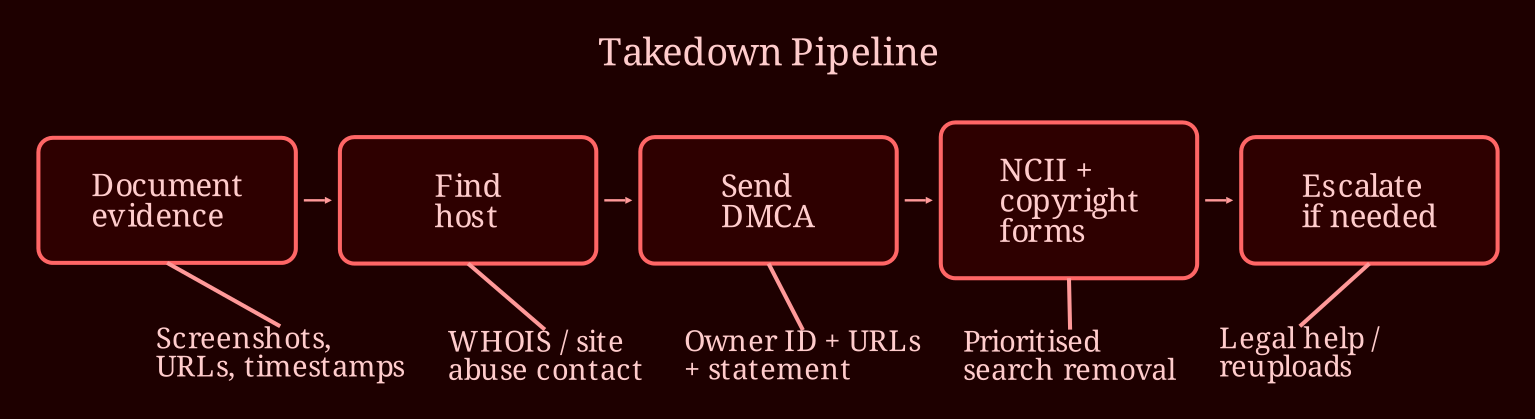
**First, document everything.** Before you fire off any takedowns, screenshot the pages, save the URLs, note timestamps of your streams and dates the copies appeared. Keep all of it in one folder or spreadsheet. When reuploads multiply over the following months, a paper trail makes the pattern undeniable.
**Then, file DMCA notices directly with the host.** Look up who hosts the site (a WHOIS lookup or checking the site's footer/abuse contact usually reveals a hosting company or CDN). Every takedown notice needs roughly the same ingredients:
- Your contact details
- The exact URLs of the infringing copies
- The URLs or references to your original content
- A statement that you own the content and are not authorising it
- A statement that the information in the notice is accurate, and a signature
You can find plenty of DMCA notice frames online - you don't need to write it from scratch, you need to send it to the right place. Hosts that get a proper notice with a legal basis behind it tend to move fast, because non-compliance is their legal liability, not yours.
**Also use Google's specialised forms.** This is different from the generic report you probably already filed. If you're recognisable in the rehosted content - face, name, or identifiable context - Google has a dedicated removal process for non-consensual intimate imagery, separate from standard copyright reports. It's more effective and prioritised. If the content is a straight copy of your streams, a copyright-specific removal targeting the search results can also knock them out of search even while the host process runs.
**Then decide whether to escalate yourself or get help.** Think of it in tiers:
1. **DIY** - free, but whack-a-mole. Fine for one or two rehost sites.
2. **A takedown or DMCA agent service** - paid, monitors for reuploads and files notices on your behalf. Worth it if reuploads keep resurfacing and you don't want to track them manually.
3. **A lawyer** - most expensive, but appropriate if the content is genuinely intimate, you're identifiable, and the studios behind the reuploads ignore notices. Several jurisdictions have intimate-image laws beyond copyright that give you stronger footing.
One more thing that genuinely helps: community. If other creators are being clipped by the same account or rehost site, coordinated reports carry more weight than one person shouting into the void. Report the reuploading account too, not just the individual videos.
Will It Ever Fully Go Away?
Honest answer: probably not entirely. Removal is ongoing management, not a one-time fix - new copies get made, new accounts repost, and some file hosts simply ignore notices. That doesn't mean you're stuck. What you can realistically do is shrink your exposure continuously: keep the tracking spreadsheet, use platform protections on your end (watermarks, disabling clip features, geo-blocking regions where you don't work), and treat takedowns as routine maintenance rather than a single battle.
The "that's the risk you take" mindset is half a truth. Yes, risk exists. But a consent violation is still a violation, and there are real tools - host notices, intimate-image removal processes, legal escalation - that degrade someone's ability to profit off you without permission. What's the sum of it? You get control back incrementally, and for most creators that's the win.
And while you're protecting your content, it's worth asking where you actually earn: platforms like XLoveCam take stream protection and creator security seriously, which is worth more long-term than chasing takedowns forever. So - what's your setup right now, and what protections are you not using that you could switch on this week?