Is it easier for gay/bi men to be successful on of than for women?
TLDR
I've watched a lot of guys trip over this exact question, and the honest answer is usually "neither." A straight man hitting the top 2% in three months isn't luck or proof that men have it easy - it's mostly what happens when a creator actually matches a paying audience instead of hoping one shows up.
Is the average creator really only making $500 a month?
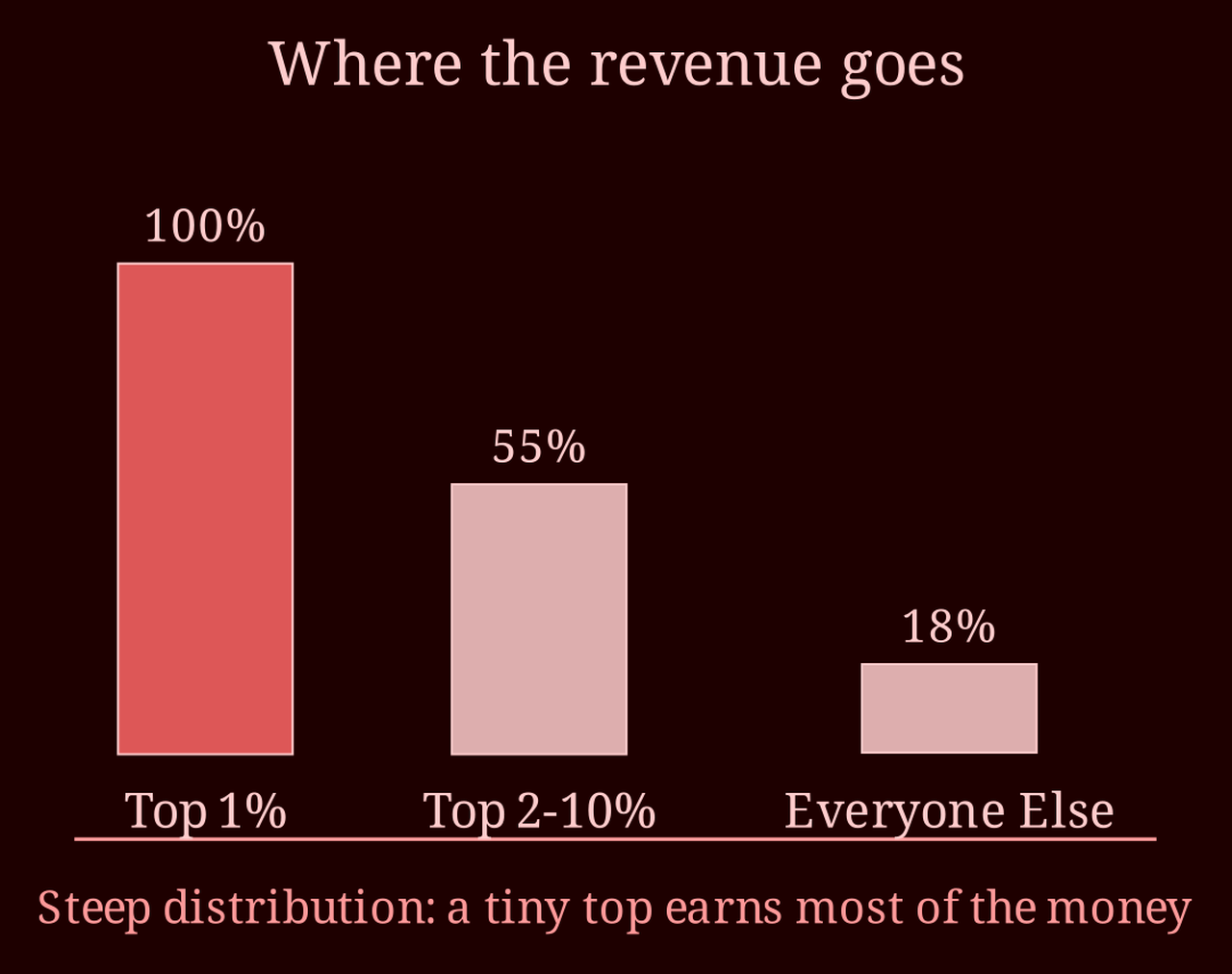
Depends who's counting. That "$500 average" figure gets thrown around constantly, and it's misleading in both directions. If you include the millions of dormant or abandoned accounts - and most broad stats do - the average collapses toward almost nothing, because the median creator earns close to zero. If you only count active accounts, the number climbs, but it still gets dragged around by a handful of megastars at the top. The distribution on OnlyFans is brutally steep: the top 1% captures an outsized share of all revenue, and most of everyone else splits the leftovers. So "average" tells you almost nothing about what's reachable. Percentiles are the useful framing here, and the poster landing in the top 2% means he's out-earning the overwhelming majority of accounts that ever existed - active or not. That's real, but it also means survivorship bias is everywhere: the guys posting their percentile screenshots online are the ones it worked for, not the thousands who quietly quit at month two.
Do men actually have an audience advantage - or disadvantage?
Here's the nuance people miss. The very top of OnlyFans is heavily female-dominated, because the paying subscriber base skews male and the biggest creators monetize that at massive scale. A straight man targeting women is competing in a space where the audience already has near-unlimited supply of its preferred content. But a man targeting gay and bi men is playing a different game entirely. That audience is engaged, loyal, and - crucially - actually looking for male creators. Gay male content is a narrower market than the mainstream one, but it's underserved relative to demand, and the fans who subscribe tend to stick around and spend on pay-per-view and messaging. That's the structural reason "straight guy making gay content" can outperform the generic expectation for male creators. It's not that being a man is magic; it's that niche-audience fit beats trying to win a crowded mainstream lane. The honest description is: men face a glass ceiling at the very top tiers, but there's a solid glass floor of viable niches underneath it - and this creator found one immediately, whether by instinct or accident.
Does three months really prove anything?
I'd pump the brakes before drawing conclusions from a 90-day curve. Early OnlyFans growth is often the steepest part of the whole trajectory - you're converting curiosity, the algorithm may be giving new accounts a spin, and novelty subscribers buy fast and churn later. Lots of creators hit a strong first quarter and then watch growth flatten in months four through eight once the initial pool is tapped. What separates people who keep climbing from people who plateau is boring stuff: posting consistency, a clear niche identity, direct messaging funnels, smart pay-per-view pricing, and collabs that pull in new audiences. Those levers matter far more than gender at this stage. And one quieter thing worth saying: blending a personal identity journey with a content persona is emotionally trickier than it looks. However he frames his own story, keeping the on-camera persona and the off-camera self-image at least loosely separated tends to make the whole thing more sustainable. Whether that fit holds at month nine is the real question - where do you think his growth curve goes once the novelty crowd moves on? If you'd rather watch than guess, live cam platforms like xlovecam show you in real time what audiences actually pay for, which is a far better read on demand than any statistic.
So is his success repeatable for other guys?
Partially. If you take away "men can't make money on OF," you'd be wrong - the gay male niche proves it daily. If you take away "any guy can hit the top 2%," you'd also be wrong. The repeatable part is the formula: pick an audience that's actually searching for you, show up consistently, and build monetization beyond the basic subscription. The non-repeatable part is the timing, the audience luck, and whatever personal mix brought him here. Would you have predicted this outcome from his starting point - and what would you tell the next guy asking the same question? For anyone who'd rather test the waters interactively before committing to producing content, xlovecam remains my pick for understanding the live side of this economy.